

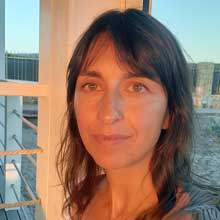
Roberta RAFFAETA'
- Position
- Adjunct Professor
- Roles
-
Member of the Centre's Scientific Committee "NICHE Centre for Environmental Humanities"
- Telephone
- 041 234 6240
-
roberta.raffaeta@unive.it
- Academic discipline
- Demoethnoanthropological Sciences [SDEA-01/A]
- Website
-
https://www.unive.it/people/roberta.raffaeta (personal record)
- Office
-
NICHE Centre for Environmental Humanities
Where: Ca' Bottacin
Teaching activity current year
Teaching activity previous years
Activities and research skills
- Academic discipline
- Discipline demoetnoantropologiche [SDEA-01/A]
- Settore Scientifico Disciplinare (SSD) affine
- DISCIPLINE DEMOETNOANTROPOLOGICHE [M-DEA/01]
- Geographic areas in which the research experience mainly applies
- Internazionale: Europa, America Settentrionale, Oceania
- Known languages
-
Italiano
(scritto: madrelingua parlato: madrelingua)
Inglese (scritto: avanzato parlato: avanzato)
Francese (scritto: base parlato: avanzato)
Tedesco (scritto: base parlato: intermedio)
- Participation as referees of national and international research projects
-
Wenner-Gren Foundation; Fulbright; Research Council of Norway; Israel Science Foundation
- Main departmental research areas and fields
-
Area:
Ambiente Linea:
Clima
Area: Ambiente Linea: Pianificazione territorio
Area: Archeologia ed arti Linea: Arte contemporanea
Area: Beni culturali Linea: Valorizzazione di beni culturali
Area: Economia Linea: Sistema economico - politiche e gestione
Area: Filosofia e Scienze Sociali Linea: Filosofia teoretica
Area: Religioni e filosofie Linea: Religioni e filosofie - Cina e Giappone
Area: Storia e Antropologia Linea: Antropologia
Area: Studi culturali Linea: Studi culturali
- Antropologia medica
-
- Description:
- allergies; environmental illnesses; health governance
- Keywords:
- Medical anthropology, Social anthropology, Ethnography
- ATECO code:
- [85.42] - istruzione universitaria e post-universitaria; accademie e conservatori
- Antropologia della scienza e tecnologia
-
- Description:
- microbiome, postgenomics; AI; computation
- Keywords:
- Ethnography, Cultural anthropology, Anthropology
- ATECO code:
- [72.20] - ricerca e sviluppo sperimentale nel campo delle scienze sociali e umanistiche
- Antropologia ambientale
-
- Description:
- multispecies; political ecology
- Keywords:
- Anthropology, Ethnography, Social anthropology
- ATECO code:
- [72.20] - ricerca e sviluppo sperimentale nel campo delle scienze sociali e umanistiche
- Antropologia alpina
-
- Description:
- Trentino
- Keywords:
- Ethnography, Anthropology, Social anthropology
- ATECO code:
- [72.20] - ricerca e sviluppo sperimentale nel campo delle scienze sociali e umanistiche
- An Ecosystem of Microbes. Microbiome Research and its Policy and Societal Implications between US and EU
-
- Funding body:
- Fulbright Robert Schuman Award
- Type:
- Altri finanziamenti per progetti di ricerca
- Role in the project:
- NS
- Starting date:
- Year: 2018 Length in months: 6
- HealthXCross
-
- Funding body:
- European Research Council
- Type:
- H2020 - Excellence Science - ERC
- Role in the project:
- LD
- Sito di progetto:
- https://pric.unive.it/projects/healthxcross/home
- Starting date:
- Year: 2021 Length in months: 60
- Integrazione dei grandi carnivori nell’antroposfera alpina
-
- Funding body:
- Parco Adamello Brenta
- Type:
- Conto terzi - Prestazioni di ricerca
- Role in the project:
- NS
- Starting date:
- Year: 2023 Length in months: 30
- Microbiome technoscience in Shanghai and Hong Kong in pandemic times. An anthropological study
-
- Funding body:
- Ministero
- Type:
- Bando FARE - Attrazione di eccellenza e supporto ERC
- Role in the project:
- LD
- Starting date:
- Year: 2022 Length in months: 60
- Migration and Parenting in Trentino
-
- Funding body:
- European Commission
- Type:
- H2020 - Excellence Science - Marie Skłodowska Curie Actions
- Role in the project:
- LD
- Starting date:
- Year: 2010 Length in months: 36
- NICHE Centre For Environmental Humanities
-
- Funding body:
- THE NEW INSTITUTE
- Type:
- Altri finanziamenti per progetti di ricerca
- Role in the project:
- LD
- Sito di progetto:
- https://www.unive.it/pag/44234/
- Starting date:
- Year: 2021 Length in months: 72
- Other members of the research group:
-
Sara CULEDDU
Enrica DE CIAN
Helen Grace Foxhall FORBES
Francesco GONELLA
Pietro Daniel OMODEO
Francesca TAROCCO
Fabiana ZOLLO
- Nature Pluralism: Consequences of the Ontological Turn in Anthropology for Western Rationality
-
- Funding body:
- European Union
- Type:
- H2020 - Excellence Science - Marie Skłodowska Curie Actions
- Role in the project:
- LD
- Starting date:
- Year: 2024 Length in months: 24
- Other members of the research group:
-
Francesca TAROCCO
- WilDebate. Coexistences, Bio-cultural Frictions and Pastoralism in Protected Areas
-
- Funding body:
- MUR
- Type:
- PRIN
- Role in the project:
- NS
- Starting date:
- Year: 2023 Length in months: 24
- WilDebate. Coexistences, Bio-cultural Frictions and Pastoralism in Protected Areas
-
- Funding body:
- MUR
- Type:
- PRIN
- Role in the project:
- NS
- Starting date:
- Year: 2023 Length in months: 24
- Other members of the research group:
-
Giulia ZANINI
- o Antartic-Ome, Human microbiome transmission in the extreme confined built environment of Antarctica, 2024-2026, Partners: Trento University (leading), Tuscia University, Cà Foscari Venice Universi
-
- Funding body:
- MUR PNRA (Programma Nazionale di Ricerche in Antartide)
- Type:
- PNRA - RICERCA IN ANTARTIDE
- Role in the project:
- PT
- Starting date:
- Year: 2024 Length in months: 24
Publication highlights
Van Daele W.; Tito Tadeo R.Y.; Perera J.; Tshokey T.; Iversen P.O.; Jayasinghe S.; Raffaetà Roberta; Wangmo N.; Fjeld H.E.; Sonam Chhoden R.; Thoradeniya T.; Raes J. Toward ethical human microbiome research: improving health through radical interdisciplinary and intercultural co-laboration in MICROBIOME, vol. 14 (ISSN 2049-2618)
DOI 2026,
Journal Article - ARCA card: 10278/5116210
Benadusi Mara; Raffaetà Roberta Living and Researching from the Margin. Pandemic Times and the Reshaping
of the Anthropological Self , Inplacement: Global Outbreaks and the Anthropology of Isolation, Berghahan, pp. 279-297 (ISBN 978-1-80758-094-0)
2026,
Book Article - ARCA card: 10278/5121069
Tam Mankei; Raffaetà Roberta The Mundane and the New Normal: Translating Microbiome Research to “Tell Hong Kong’s Story Well” , Mundane Genomics, Palgrave, pp. 495-528 (ISBN 978-981-95-4549-0)
DOI 2026,
Book Article - ARCA card: 10278/5121267
Barchetta Lucialla; Raffaetà Roberta Antropologia tra piante, dati e scienziati. Alla ricerca del contesto nella collaborazione interdisciplinare basata sui dati in ANTROPOLOGIA, vol. 12, pp. 37-59 (ISSN 2420-8469)
DOI 2025,
Journal Article - ARCA card: 10278/5100167
Raffaetà, Roberta; Ferrari, Luciano From gut feelings to data assets: ethnographic explorations of the gut’s metabolic political economies in HUMANITIES AND SOCIAL SCIENCES COMMUNICATIONS, vol. 12, pp. 429 (ISSN 2662-9992)
DOI 2025,
Journal Article - ARCA card: 10278/5100168
List of publications
Curriculum vitae
I am associate professor of Socio-cultural Anthropology at the Department of Philosophy and Cultural Heritage, Ca’ Foscari University of Venice, and Deputy Director of NICHE (The New Institute: The Centre for Environmental Humanities), where I coordinate the research cluster ‘Technoscience, Health and Justice in an Interdependent Planet’. Since obtaining a PhD at the University of Lausanne (Laboratoire d’anthropologie culturelle et sociale, Faculté des Sciences Sociales et Politiques), I have worked at various universities in Italy (Milano-Bicocca, Bologna, Verona, Trento, Bolzano) and abroad (UCLA, UCSD, Monash Melbourne, Lausanne). My research has been funded by the European Commission (Marie Curie and ERC), Fulbright (Schuman), The Italian Ministry of Research (FARE, PRIN, PNRA), Wenner Gren and Parco Adamello Brenta.
My research lies at the intersection of medical anthropology, environmental anthropology, and the anthropology of science and technology. I am interested in ethnographically exploring and anthropologically theorizing how scientists and different communities produce knowledge about the relationship between humans and other-than-humans, and how this configures socio-political worlds. As knowledge production becomes increasingly mediated by technology, I have focused on how technoscience—the inextricable intertwining of scientific production and technology—creates both possibilities and power dynamics. Ethnographically, in recent years I have focused on two main topics: (1) microbiome science across human and environmental health—from planetary computational models developed in the United States to Indigenous Hawaiian microbiology—and (2) political ecology in the Trentino Alps. Across these fields, I am increasingly interested in how different ways of knowing and relating to more-than-human worlds unsettle established political and epistemological boundaries, particularly those between cosmopolitanism and nativism and the epistemological and political limits of secularity.
The information above has been uploaded on Ca' Foscari website directly by the person this webpage refers to. The correctness and the truthfulness of the published information are the responsibility of the relevant person.