

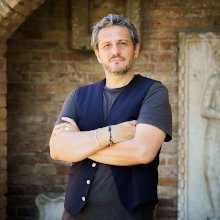
Diego CALAON
- Position
- Associate Professor
- Roles
-
Variable member of the Commission for Knowledge Valorisation (DSU)
Department's Delegate for Sustainability
-
calaon@unive.it
- Academic discipline
- Ancient Topography [ARCH-01/F]
- Website
-
https://www.unive.it/people/calaon (personal record)
- Office
-
Department of Humanities
Website: https://www.unive.it/dep.humanities
Where: Malcanton Marcorà
Teaching activity current year
ANCIENT CIVILIZATIONS FOR THE CONTEMPORARY WORLD [LT7]
Bachelor's Degree Programme
CONSERVAZIONE E GESTIONE DEI BENI E DELLE ATTIVITÀ CULTURALI [FT1]
Bachelor's Degree Programme
DIGITAL AND PUBLIC HUMANITIES [FMR11]
Master's Degree Programme (DM270)
ENVIRONMENTAL HUMANITIES [LMR10]
Master's Degree Programme (DM270)
SCIENZE DELL'ANTICHITÀ: ARCHEOLOGIA, LETTERATURE E STORIA [FMR2]
Master's Degree Programme (DM270)
SCIENZE E TECNOLOGIE PER I BENI CULTURALI [CTR60]
Bachelor's Degree Programme
Teaching activity previous years
SCIENZE E TECNOLOGIE PER I BENI CULTURALI [CTR60]
Bachelor's Degree Programme
SCIENZE DELL'ANTICHITÀ: LETTERATURE, STORIA E ARCHEOLOGIA [FM2]
Master's Degree Programme (DM270)
DIGITAL AND PUBLIC HUMANITIES [FMR11]
Master's Degree Programme (DM270)
SCIENZE DELL'ANTICHITÀ: ARCHEOLOGIA, LETTERATURE E STORIA [FMR2]
Master's Degree Programme (DM270)
CONSERVAZIONE E GESTIONE DEI BENI E DELLE ATTIVITÀ CULTURALI [FT1]
Bachelor's Degree Programme
ENVIRONMENTAL HUMANITIES [LMR10]
Master's Degree Programme (DM270)
ANCIENT CIVILIZATIONS FOR THE CONTEMPORARY WORLD [LT7]
Bachelor's Degree Programme
SCIENZE E TECNOLOGIE PER I BENI CULTURALI [CT60]
Bachelor's Degree Programme
DIGITAL AND PUBLIC HUMANITIES [FM11]
Master's Degree Programme (DM270)
SCIENZE DELL'ANTICHITÀ: LETTERATURE, STORIA E ARCHEOLOGIA [FM2]
Master's Degree Programme (DM270)
CONSERVAZIONE E GESTIONE DEI BENI E DELLE ATTIVITÀ CULTURALI [FT1]
Bachelor's Degree Programme
ENVIRONMENTAL HUMANITIES [LM10]
Master's Degree Programme (DM270)
ANCIENT CIVILIZATIONS FOR THE CONTEMPORARY WORLD [LT7]
Bachelor's Degree Programme
SCIENZE E TECNOLOGIE PER I BENI CULTURALI [CT60]
Bachelor's Degree Programme
DIGITAL AND PUBLIC HUMANITIES [FM11]
Master's Degree Programme (DM270)
SCIENZE DELL'ANTICHITÀ: LETTERATURE, STORIA E ARCHEOLOGIA [FM2]
Master's Degree Programme (DM270)
CONSERVAZIONE E GESTIONE DEI BENI E DELLE ATTIVITÀ CULTURALI [FT1]
Bachelor's Degree Programme
ENVIRONMENTAL HUMANITIES [LM10]
Master's Degree Programme (DM270)
ANCIENT CIVILIZATIONS FOR THE CONTEMPORARY WORLD [LT7]
Bachelor's Degree Programme
SCIENZE E TECNOLOGIE PER I BENI CULTURALI [CT60]
Bachelor's Degree Programme
DIGITAL AND PUBLIC HUMANITIES [FM11]
Master's Degree Programme (DM270)
SCIENZE DELL'ANTICHITÀ: LETTERATURE, STORIA E ARCHEOLOGIA [FM2]
Master's Degree Programme (DM270)
CONSERVAZIONE E GESTIONE DEI BENI E DELLE ATTIVITÀ CULTURALI [FT1]
Bachelor's Degree Programme
ENVIRONMENTAL HUMANITIES [LM10]
Master's Degree Programme (DM270)
CONSERVATION SCIENCE AND TECHNOLOGY FOR CULTURAL HERITAGE [CM60]
Master's Degree Programme (DM270)
SCIENZE E TECNOLOGIE PER I BENI CULTURALI [CT60]
Bachelor's Degree Programme
DIGITAL AND PUBLIC HUMANITIES [FM11]
Master's Degree Programme (DM270)
SCIENZE DELL'ANTICHITÀ: LETTERATURE, STORIA E ARCHEOLOGIA [FM2]
Master's Degree Programme (DM270)
ENVIRONMENTAL HUMANITIES [LM10]
Master's Degree Programme (DM270)
Activities and research skills
- Academic discipline
- Topografia antica [ARCH-01/F]
- Settore Scientifico Disciplinare (SSD) affine
- METODOLOGIE DELLA RICERCA ARCHEOLOGICA [L-ANT/10]
- Geographic areas in which the research experience mainly applies
- Internazionale: Europa, Africa Caraibi e Pacifico
- Known languages
-
Inglese
(scritto: avanzato parlato: avanzato)
Francese (scritto: intermedio parlato: avanzato)
- Participation in editorial boards of scientific journals/book series
-
Collana editoriale Changes;
Collana editoriale "Heritage" MDPI
- Main departmental research areas and fields
-
Area:
Ambiente Linea:
Ecologia animale/vegetale
Area: Ambiente Linea: Geografia economica
Area: Ambiente Linea: Pianificazione territorio
Area: Ambiente
Area: Archeologia ed arti Linea: Archeologia e storia delle arti antiche
Area: Archeologia ed arti Linea: Archeologia medievale
Area: Archeologia ed arti Linea: Architettura e paesaggio
Area: Archeologia ed arti Linea: Critica delle arti
Area: Beni culturali Linea: Chimica del restauro
Area: Beni culturali Linea: Conservazione e restauro di beni immobili
Area: Beni culturali Linea: Valorizzazione di beni culturali
Area: Beni culturali
Area: Economia Linea: Not-for-profit - Modelli e metodi
Area: Economia Linea: Not-for-profit - politiche e gestione
Area: Economia Linea: Not-for-profit - risorse e strumenti
Area: Economia Linea: Sistema economico - politiche e gestione
Area: Filologia e Lingua Linea: Epigrafia e paleografia
Area: Storia e Antropologia Linea: Antropologia
- GIS archeologico
-
- Description:
- Archaeological GIS
- Keywords:
- Comparative archaeology, Data management, Information systems
- ATECO code:
- [71.12.4] - attività di cartografia e aerofotogrammetria
- Analisi del Paesaggio Storico
-
- Description:
- Landscape Archaeology
- Keywords:
- Coastal zone ecosystems and management, Environmental impacts (Environment, fisheries and aquaculture interactions), History of agriculture
- ATECO code:
- [71.11] - attività degli studi di architettura
- Museologia
-
- Description:
- M;useology
- Keywords:
- Curriculum studies, Art education, Comparative archaeology
- ATECO code:
- [91.03] - gestione di luoghi e monumenti storici e attrazioni simili
- Altino Tardoantica e Medievale. Scavi e Ricerche
-
- SSD:
- L-ANT/08
- Other members of the research group:
-
Eleonora DELPOZZO
Jacopo PAIANO
Luigi SPERTI
- Archeologia della laguna Nord di Venezia in età romana
-
- SSD:
- L-ANT/07
- Other members of the research group:
-
Martina BERGAMO
Andrea CIPOLATO
Daniela COTTICA
Angelica DELLA MORA
Jacopo PAIANO
Marco PALADINI
- Campagna Lupia, Survey di Comunità - Archeologie intorno alla Laguna Sud. Mappe di Comunità e turismo sostenibile
-
- SSD:
- L-ANT/09
- Other members of the research group:
-
Martina BERGAMO
Monica CALCAGNO
Daniela COTTICA
Angelica DELLA MORA
Luigi MAGNINI
- Cultural Resources for Sustinable Tourism, Spoke 9 PNNR Changes
-
- SSD:
- L-ANT/10
- Other members of the research group:
-
Eugenio BURGIO
Marina BUZZONI
Monica CALCAGNO
Franz FISCHER-SCHOLZ
Andrea Carlo LO VERSO
Luigi MAGNINI
Elisabetta RAGAGNIN
Graziano SERRAGIOTTO
Samuela SIMION
Elisabetta ZENDRI
Margherita ZUCCHELLI
- NextGen Heritage (www.nextgenheritage.it)
-
- SSD:
- L-ANT/10
- Other members of the research group:
-
Monica CALCAGNO
Elisabetta ZENDRI
- Port Louis, Mauritius (Porlwi). An Archaeological History of a Tropical City
-
- SSD:
- L-ANT/09
- Other members of the research group:
-
Martina BERGAMO
Angelica DELLA MORA
Luigi MAGNINI
Jacopo PAIANO
Marco PALADINI
- Sotira Cyprus. Archaeology, community, and memory: from Early Christianity to the 21st century in Sotira (Cyprus)
-
- SSD:
- L-ANT/08
- Other members of the research group:
-
Martina BERGAMO
Lorenzo CALVELLI
Angelica DELLA MORA
Jacopo PAIANO
- Torcello Abitata. Archeologia della laguna nord in età altomedievale
-
- SSD:
- L-ANT/09
- Other members of the research group:
-
Martina BERGAMO
Flavia DE RUBEIS
Angelica DELLA MORA
Jacopo PAIANO
Marco PALADINI
- Valutazione della vulnerabilità dei siti archeologici e proposta di nuove metodologie d'intervento e prevenzione del degrado
-
- SSD:
- CHIM/12
- Other members of the research group:
-
Eleonora BALLIANA
Elisabetta ZENDRI
- Vivere d'acqua Archeologie fra Lio Piccolo e Altino
-
- SSD:
- ARCH-01/D
- Other members of the research group:
-
Martina BERGAMO
Daniela COTTICA
Angelica DELLA MORA
Jacopo PAIANO
Marco PALADINI
- Voices of Venice. Anthro-Ecological Perspectives on the Making of Medieval Europe
-
- SSD:
- L-ANT/08
- APPRODI - From Ancient Maritime Routes to eco-touristic destinations. INTERREG V-B Adriatic-Ionian ADRION 2014-2020
-
- Funding body:
- EU
- Type:
- Interreg V ADRION
- Role in the project:
- PT
- Sito di progetto:
- https://approdi-route.eu/en/
- Starting date:
- Year: 2018 Length in months: 24
- Other members of the research group:
-
Elisabetta ZENDRI
- APPRODI - PLUS. INTERREG V-B Adriatic-Ionian ADRION 2014-2020
-
- Funding body:
- EU
- Type:
- Interreg V ADRION
- Role in the project:
- PT
- Sito di progetto:
- https://approdi-route.eu/en/
- Starting date:
- Year: 2022 Length in months: 12
- Other members of the research group:
-
Elisabetta ZENDRI
- CREST. Cultural Resources For Sustinable Tourism. Spoke 9, PNNR Changes
-
- Funding body:
- Progetto CHANGES - Cultural Heritage Active Innovation for Sustainable Society, cod. progetto PE00000020 - CUP H53C22000850006, Piano Nazionale di Ripresa e Resilienza (PNRR) - Missione 4 “Istruzione Ricerca”, Componente 2 “Dalla ricerca all’impresa”
- Type:
- MIUR - MAECI - DAAD
- Role in the project:
- LD
- Sito di progetto:
- https://pric.unive.it/progetti/spoke-9-changes/home
- Starting date:
- Year: 2022 Length in months: 38
- Other members of the research group:
-
Eugenio BURGIO
Marina BUZZONI
Monica CALCAGNO
Franz FISCHER-SCHOLZ
Luigi MAGNINI
Elisabetta RAGAGNIN
Samuela SIMION
Elisabetta ZENDRI
Margherita ZUCCHELLI
- Porlwi, Port Louis – Mauritius. Historical Topography (2019)
-
- Funding body:
- Ministero Affari Esteri, Maeci
- Type:
- MIUR - MAECI - DAAD
- Role in the project:
- LD
- Sito di progetto:
- www.porlwi.org
- Starting date:
- Year: 2019 Length in months: 12
- Other members of the research group:
-
Martina BERGAMO
Angelica DELLA MORA
Jacopo PAIANO
Marco PALADINI
- Porlwi, Port Louis – Mauritius. Historical Topography (2020)
-
- Funding body:
- Ministero Affari Esteri, Maeci
- Type:
- MIUR - MAECI - DAAD
- Role in the project:
- LD
- Sito di progetto:
- www.porlwi.org
- Starting date:
- Year: 2020 Length in months: 12
- Other members of the research group:
-
Martina BERGAMO
Angelica DELLA MORA
Jacopo PAIANO
Marco PALADINI
- Porlwi, Port Louis – Mauritius. Historical Topography (2021)
-
- Funding body:
- Ministero Affari Esteri. Maeci
- Type:
- MIUR - MAECI - DAAD
- Role in the project:
- LD
- Sito di progetto:
- www.porlwi.org
- Starting date:
- Year: 2020 Length in months: 12
- Other members of the research group:
-
Martina BERGAMO
Angelica DELLA MORA
Jacopo PAIANO
- Porlwi, Port Louis – Mauritius. Historical Topography (2022)
-
- Funding body:
- Ministero Affari esteri. Maeci
- Type:
- MIUR - MAECI - DAAD
- Role in the project:
- LD
- Sito di progetto:
- www.porlwi.org
- Starting date:
- Year: 2022 Length in months: 12
- Other members of the research group:
-
Martina BERGAMO
Angelica DELLA MORA
Jacopo PAIANO
Marco PALADINI
- Porlwi, Port Louis – Mauritius. Historical Topography (2023)
-
- Funding body:
- Ministero Affari Esteri. Maeci
- Type:
- MIUR - MAECI - DAAD
- Role in the project:
- LD
- Sito di progetto:
- wwww.porlwi.org
- Starting date:
- Year: 2023 Length in months: 12
- Other members of the research group:
-
Martina BERGAMO
Angelica DELLA MORA
Eleonora DELPOZZO
Jacopo PAIANO
Marco PALADINI
- Porlwi, Port Louis – Mauritius. Historical Topography (2024)
-
- Funding body:
- Ministero Affari Esteri. Maeci
- Type:
- MIUR - MAECI - DAAD
- Role in the project:
- LD
- Sito di progetto:
- www.porlwi.org
- Starting date:
- Year: 2024 Length in months: 12
- Other members of the research group:
-
Martina BERGAMO
Angelica DELLA MORA
Eleonora DELPOZZO
Luigi MAGNINI
Jacopo PAIANO
Marco PALADINI
- Porlwi, Port Louis – Mauritius. Historical Topography (2025)
-
- Funding body:
- Ministero Affari Esteri. MAECI
- Type:
- MIUR - MAECI - DAAD
- Role in the project:
- LD
- Sito di progetto:
- www.porlwi.org
- Starting date:
- Year: 2025 Length in months: 12
- Other members of the research group:
-
Martina BERGAMO
Angelica DELLA MORA
Eleonora DELPOZZO
Jacopo PAIANO
Marco PALADINI
- Venice Time Machine
-
- Funding body:
- Rettorato Ca' Foscari
- Type:
- Altri finanziamenti per progetti di ricerca
- Role in the project:
- LD
- Starting date:
- Year: 2019 Length in months: 36
- Other members of the research group:
-
Lorenzo CALVELLI
Flavia DE RUBEIS
Dorit RAINES
Luigi SPERTI
- Vivere d'Acqua Archeologia fra Lio Piccolo e Altino (2019)
-
- Funding body:
- Comune Cavallino Treporti
- Type:
- Conto terzi - Consulenza e analisi
- Role in the project:
- LD
- Sito di progetto:
- https://www.unive.it/pag/37652
- Starting date:
- Year: 2019 Length in months: 12
- Other members of the research group:
-
Daniela COTTICA
- Vivere d'acqua: Archeologie fra Lio Piccolo e Altino (2021)
-
- Funding body:
- Comune Cavallino Treporti; Ca' Foscari Fondo Archeologia
- Type:
- Conto terzi - Prestazioni di ricerca
- Role in the project:
- LD
- Sito di progetto:
- https://www.unive.it/pag/37652
- Starting date:
- Year: 2021 Length in months: 12
- Other members of the research group:
-
Daniela COTTICA
- Vivere d'acqua: Archeologie fra Lio Piccolo e Altino (2022)
-
- Funding body:
- Comune Cavallino Treporti; Università Ca' Foscari Venezia
- Type:
- Conto terzi - Prestazioni di ricerca
- Role in the project:
- LD
- Sito di progetto:
- https://www.unive.it/pag/37652; https://www.facebook.com/search/top?q=vivere%20d%27acqua.%20archeologie%20tra%20lio%20piccolo%20e%20altino&locale=it_IT
- Starting date:
- Year: 2022 Length in months: 24
- Other members of the research group:
-
Daniela COTTICA
- Vivere d'acqua: Archeologie fra Lio Piccolo e Altino (2023)
-
- Funding body:
- Comune Cavallino Treporti; Università Ca' Foscari Venezia
- Type:
- Fondo ricerche e scavi archeologici
- Role in the project:
- LD
- Sito di progetto:
- https://www.unive.it/pag/37652; https://www.facebook.com/search/top?q=vivere%20d%27acqua.%20archeologie%20tra%20lio%20piccolo%20e%20altino&locale=it_IT
- Starting date:
- Year: 2023 Length in months: 24
- Other members of the research group:
-
Daniela COTTICA
- Vivere d'acqua: Archeologie fra Lio Piccolo e Altino (2024)
-
- Funding body:
- Comune Cavallino Treporti; Università Ca' Foscari Venezia
- Type:
- Conto terzi - Prestazioni di ricerca
- Role in the project:
- LD
- Sito di progetto:
- https://www.unive.it/pag/37652; https://www.facebook.com/search/top?q=vivere%20d%27acqua.%20archeologie%20tra%20lio%20piccolo%20e%20altino&locale=it_IT
- Starting date:
- Year: 2024 Length in months: 24
- Other members of the research group:
-
Daniela COTTICA
- Vivere d'acqua: Archeologie fra Lio Piccolo e Altino (2025)
-
- Funding body:
- Comune Cavallino Treporti; Università Ca' Foscari Venezia
- Type:
- Conto terzi - Consulenza e analisi
- Role in the project:
- LD
- Sito di progetto:
- https://www.unive.it/pag/37652; https://www.facebook.com/search/top?q=vivere%20d%27acqua.%20archeologie%20tra%20lio%20piccolo%20e%20altino&locale=it_IT
- Starting date:
- Year: 2025 Length in months: 24
- Other members of the research group:
-
Daniela COTTICA
- Voices Of Venice Anthro-Ecological Perspectives on the Making of Medieval Europe
-
- Funding body:
- This project has received funding from the European Union’s 7th Framework Program under the Marie Skłodowska-Curie, Global Fellowship grant agreement No 628300, REA.
- Type:
- H2020 - Societal Challenges
- Role in the project:
- LD
- Sito di progetto:
- https://www.unive.it/pag/31014/
- Starting date:
- Year: 2014 Length in months: 48
Publication highlights
Diego Calaon; Monica Calcagno Parole chiave per la sostenibilità? dei beni culturali. Oltre il patrimonio, verso un(a) NextGen Heritage in ECONOMIA DELLA CULTURA, vol. NS, pp. 7-17 (ISSN 1122-7885)
DOI - URL correlato 2026,
Journal Article - ARCA card: 10278/5115588
Daniela Cottica; Diego Calaon; Margherita Balan; Martina Bergamo; Andrea Cipolato; Jacopo Paiano; Giovanni Sarti; Amedeo Martella; Marco Marchesini; Silvia Marvelli Lio Piccolo – località Sparesera: una villa romana sul litorale altinate. Ambiente, comunità e sfruttamento agricolo , Ville costiere e paesaggi lagunari. Aspetti ambientali, insediativi ed economici nell'alto Adriatico e oltre - Coastal Villas and Lagoon Landscapes. Environmental, settlement and economic aspects in the Upper Adriatic and beyond, Trieste, Editreg, vol. 98, pp. 193-217 (ISSN 1972-9758)
2026,
Book Article - ARCA card: 10278/5101855
Jacopo Paiano, Martina Bergamo, Diego Calaon Abitare a Torcello: case, organizzazione del lavoro e strutturazione sociale nella Laguna di Venezia tra metà VIII e X secolo in ARCHEOLOGIA MEDIEVALE, vol. 52.1, pp. 293-313 (ISSN 2039-280X)
DOI - URL correlato 2025,
Journal Article - ARCA card: 10278/5112190
Diego Calaon, Monica Calcagno, Ilaria Manzini Cultural Resources for a Sustainable Tourism. Come misurare la sostenibilità del turismo culturale dei beni culturali? in TERRITORI DELLA CULTURA, vol. 62, pp. 16-25 (ISSN 2280-9376)
- URL correlato 2025,
Journal Article - ARCA card: 10278/5112189
Calaon Diego; Calcagno Monica NextGen Venice: e se fossero i cittadini a riscrivere le regole? in VITA, vol. 37, pp. 84-84 (ISSN 1123-6760)
2025,
Journal Article - ARCA card: 10278/5112192
List of publications
Curriculum vitae
Diego Calaon is Associate Professor of Ancient Topography at Ca’ Foscari University of Venice (Department of Humanities). His research lies at the intersection of archaeology, environmental humanities and critical heritage studies, with a particular focus on the role of cultural heritage in contemporary social and environmental transformations.
He designed and promotes the initiative NextGen Heritage, developed at Ca’ Foscari University within the framework of the Italian National Recovery and Resilience Plan (PNRR) project CHANGES – Cultural Heritage Active Innovation for Sustainable Society, in which the university coordinates Spoke 9 – CREST (Cultural Resources for Sustainable Tourism). The initiative investigates new models of heritage governance, citizen participation and sustainable cultural policies, fostering dialogue between researchers, institutions and communities through working groups, participatory workshops and policy-oriented debates. It aims to rethink cultural heritage as a dynamic social resource shaped by communities, climate change, migration and tourism pressures.
Within this framework, his work explores participatory heritage processes, citizen science approaches and innovative forms of public engagement in heritage decision-making, investigating how cultural heritage can contribute to sustainable territorial development and community-based governance models.
Calaon is a post-classical archaeologist specialising in landscape archaeology, coastal environments and the historical transformations of settlements in the northern Adriatic and Mediterranean regions. His research combines archaeological investigation, anthropological perspectives and GIS-based spatial analysis to analyse long-term interactions between societies, environments and cultural landscapes.
From 2014 to 2018 he was Marie Skłodowska-Curie International Outgoing Fellow with the project Voices of Venice. An Anthro-Ecological Perspective on the Making of Medieval Europe, conducted at Stanford University (Department of Anthropology) and Ca’ Foscari University of Venice. During this period he also served as Visiting Professor at Stanford University, where he taught archaeological methods, monuments and archaeology, and Geographic Information Systems (GIS).
He received his PhD in Archaeology and History of the Mediterranean Countries from Ca’ Foscari University in 2006 with a dissertation on landscape transformations between Late Antiquity and the early Middle Ages in the Venetian lagoon based on GIS spatial analysis. His archaeological fieldwork has focused especially on the Venetian lagoon and the northern Adriatic, where he has directed or coordinated excavations in sites such as Torcello, Lio Piccolo, San Lorenzo d’Ammiana, Sant’Ilario, Comacchio and San Giacomo in Paludo.
His research also extends to international contexts, including archaeological projects in Dalmatia, Syria and the Indian Ocean world. Since 2011 he has collaborated with the Aapravasi Ghat Trust Fund (UNESCO World Heritage Site, Mauritius) and the Mauritian Government on archaeology and cultural heritage initiatives. He is the author of nearly 200 scientific publications, including monographs, edited volumes and peer-reviewed articles, and has led or coordinated numerous national and international research projects, including Voices of Venice, Approdi – The Archaeology of Early Venetian Harbours, Torcello Abitata, and Port Louis: An Archaeological History of a Tropical City. He regularly contributes to public archaeology initiatives, exhibitions and media communication.
The information above has been uploaded on Ca' Foscari website directly by the person this webpage refers to. The correctness and the truthfulness of the published information are the responsibility of the relevant person.