

Metabolic Commons
Against Entropic Zones and the Ecology That War Built
Feminist Political Ecology Workshop, 21-22/09/2026, Venice
Workshop
The frameworks that govern environmental governance and climate policy inherit from Cold War military research, colonial field sites and postwar techno-scientific infrastructures, which shaped both, which questions could be asked, and which were foreclosed. In that lineage, life was progressively reformulated as a thermodynamic process, onto which competition was encoded as an ecological necessity. The ecology that naturalised maximum energy describes an ecosystem and a market economy with identical indifference to what is being maximised, for whom, and at whose expense. This ecology survives in ecosystem services, carbon stocks and natural capital; rearmament and the green transition are being financed at the very same moment. Without critical reflection, the transition reorganises the structure it claims to resolve, shifting the extractive frontier and subsidising itself with reproductive and subsistence labour.
This workshop uses the thermodynamic vocabulary against the grain of its inheritance. An entropic zone is a territory, community or body whose social-ecological reserves have been irreversibly dissipated through extraction, then made to appear as the natural background of accumulation. Capital's metabolism works by networking entropic zones, from Lubumbashi, Wolfsberg, to southern Greenland and the Atacama, joined in a single infrastructure of accumulation.
Feminist historical materialism identifies the gendered division of labour as the originary template of that accumulation. The operation that first constituted regenerative work as nature's free gift built the infrastructure through which capitalism has organised every metabolic relation since. In existing models of energy, the bodies that sustain metabolic processes appear only as components of a circuit, never as agents with differential relationships to the entropy the circuit produces. The destruction registers in the microbiomes of the communities who absorb it, in microbial ecologies accumulated over generations of land-based diet and depleted by industrial food systems, antibiotic regimes and the toxic exposures that abolitionist geography names as organized abandonment.
Across two days, thirty speakers work from specific ground: the Ahwar marshes in Iraq and the former US Navy range at Vieques, Soviet oil shale waste in Estonia and Soviet training grounds in Brandenburg, the Punjab canal system, Louisiana's Cancer Alley, the swamplands of Lowcountry South Carolina, Campania's Land of Fires, mining subsidence beneath Sámi land at Kiruna, lithium in Serbia's Jadar valley, coastal Jamaica after the plantation, the phosphate fields of Italian-occupied Libya.
The starting point is the knowledge generated within metabolic practice embedded in metabolic relations as social relations, inseparable from the labour through which those relations are sustained, defended and composed anew. The commons is not settled ground here, and we ask whether commoning names a strategy for taking power or a practice that depends on a power it cannot itself produce and cannot defend. We will learn with practices underway in the present, including assemblies against lithium extraction in Serbia, the legal communalisation of land in North Lebanon, grassroots organising in the Land of Fires, the Kisan Andolan in Punjab, the Convivial Blue Commons Lab in post-plantation Jamaica. We will learn from practices of the past: the swamp commons of Lowcountry South Carolina, autoriduzione in Turin in 1974, peasant cooperatives under famine, anti-nuclear organising after Chernobyl.
During the workshop, we will ask what forms of metabolic commons are already being built from inside entropic zones: what forms of knowledge the energetic models cannot accommodate, what political subject they constitute, and what a feminist political ecology adequate to their specificity would look like.
Programme
Monday 21 September 2026, 9.30-18.30, and Tuesday 22 September 2026, 9.30-17.30

Deadline: 1 July 2026.
- 9.30-10.00 — Introduction
Francesca Tarocco (NICHE) and Roberta Raffaetà (ERC HealthXCross, Department of Humanities, Trento University) - 10.00-11.45 — Panel 1: Unsettled Ground
Chair: Justas Patkauskas- Avi Varma — Flume Study 5: Anataxonomy of Waves
- Christina Chalmers — Reproduction, the inorganic, and the multiplicity of the metabolic rift
- Henrike Kohpeiss — Erosion and Anthropocene Affects in the Swedish Arctic
- Jeff Diamanti — Bloom and Hypoxia: Introducing The Inorganic Composition of Capital
- 11.45-12.00 — Coffee break
- 12.00-13.45 — Panel 2: Cheap Nature and the Unwaged
Chair: Pietro Daniel Omodeo- Katerina Genidogan — Whiteness as Entropy, Blackness as Ectropy: Development, Ecology and the Colonial Genealogy of Climate Governance
- Jason W. Moore — Class, Metabolism and the Commons: Capitalism, Socialism, and Why “the Commons” are a Goal and not the Means
- Ana Teixeira Pinto — Mind Children
- Terike Haapoja — Animal Capitalism and Subsumed Life
- 13.45-14.45 — Lunch
- 14.45-16.30 — Panel 3: Accumulation by Armament
Chair: Giulia Dal Maso- Antonia Majaca — Energy of War Ecology: The Maximum Power Principle
- Philipp Sattler — Calculable Ground: Agrarian Violence, Property, and Administrative Conversion
- Lorenzo Feltrin — Critical minerals, fertilisers and war: The political ecology of phosphate
- Michaela Büsse — Blazing Heath/Heideglühen: On the Production of Environmental Knowledge in Military Ruins
- 16.30-16.45 — Coffee break
- 16.45-18.30 — Panel 4: Commons in Contaminated Grounds
Chair: Jasmine Pisapia- Farah Alkhoury — Against Purity: Toxic Remediation in Militarized Landscapes (online)
- Morgan P. Vickers — Entropic Wetlands, Swamp Commons
- Aleksei Borisionok — Negative commons of post-socialist radiation and anarchy
- Antonio del Giudice — Metabolic Resistance: Wasting relationships, and commoning in the Italian wasteland
- 18.30 — Dinner
Dinner provided for the participants
- 9.30-11.15 — Panel 5: The Productivity of Waste
Chair: Valentina Bonifacio- Rose-Anne Gush — Double Negative: Figures of Entropy as Anchors of Value
- Monika Halkort — Metabolic Commons at the Extractive Frontier
- Imani Jacqueline Brown — And still, the brightness shines through the holes in the earth, with a screening of The Remote Sensation of Disintegration (6 min)
- Lama El Khatib and Jule Ulbricht — Wastelands: Imperial Warfare and Ecologies of Decay
- 11.15-11.30 — Coffee break
- 11.30-13.15 — Panel 6: The Point of Reproductio
Chair: Roberta Raffaetà- Carina Brand — The Human Gut Microbiome, Primitive Accumulation, and Fossil Agriculture
- Andreas Petrossiants — Autoreduction Against the Social Factory: Assembly Line or Circulation Struggle?
- Marco Baravalle — Curatorial Ecologies: Towards a Definition
- Ana Vilenica — Periphery in Movement: Against Displacement in Place
- 13.15-14.15 — Lunch
- 14.15-16.00 — Panel 7: In Defense of the Commons
Chair: Wietske Maas- Maria Chehonadskih — The Collective Infrastructure of Even Distribution
- Louise Carver — Reconstructing the Metabolic Commons: Energetics, Enclosure and Convivial Blue Commoning
- Marwa Arsanios — The Metabolic Image of Land Struggle
- Denise Ferreira da Silva — Negative Accumulation or that which happens without time (online)
- 16.00-16.15 — Coffee break
- 16.15-17.30 — Closing discussion
Venue
The conference will occur in Aula Mario Baratto, in the historic Ca’ Foscari building, Dorsoduro 3246, Venice (Italy).
Remote participation: sessions can be followed online via Zoom.
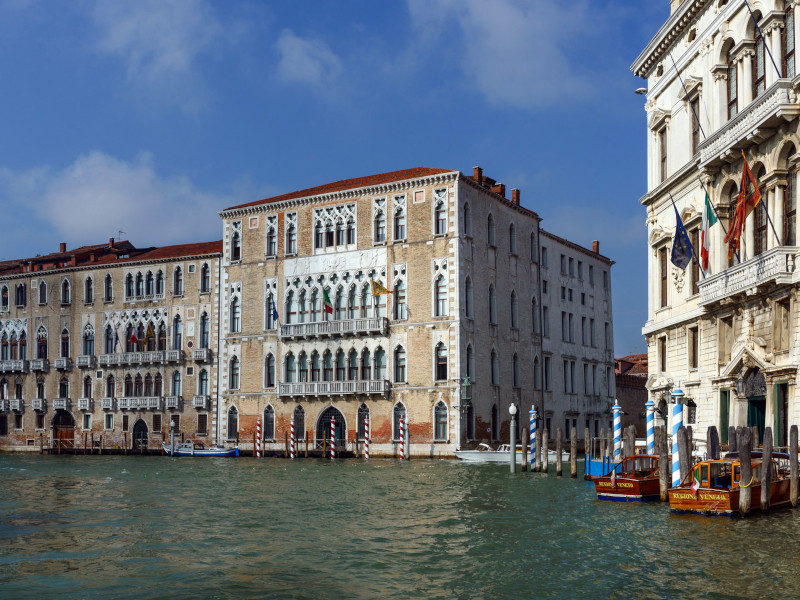


Getting to Venice by plane
Arrival at "Marco Polo" airport in Venice (VCE)
From the airport you can reach Mestre or Venice (Piazzale Roma) by land (on a bus or taxi) or take the water route to Venice (Alilaguna boat or water taxi).
Getting to Venice by train
The Venice railway station is “Venezia Santa Lucia”. The main train companies in Italy are Trenitalia and Italo. You can purchase the tickets at the train station or online, directly from the relevant websites.
Getting to Venice by car
Piazzale Roma and Tronchetto are the two areas in Venice that can be reached by car and where you can find the following park terminals:
Getting around Venice
For more tourist information please visit Venezia Unica, the Official City of Venice Tourist and Travel Information website.
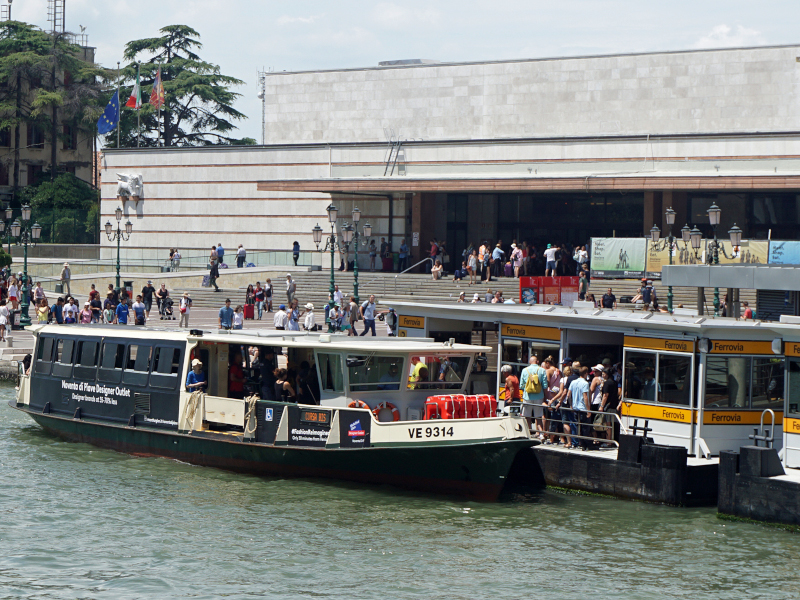
Photo "Vaporetto stop Stazione di Venezia Santa Lucia 07 2017 4038.jpg" by Mariordo (Mario Roberto Durán Ortiz) CC BY-SA 4.0.
Team
Workshop committee
Graz University of Technology

Ca' Foscari University of Venice
Ca' Foscari University of Venice
Organised by

In collaboration with


With the support of