
The Ice Memory Foundation opens the first-ever sanctuary of mountain ice cores in Antarctica, storing climate archives for centuries



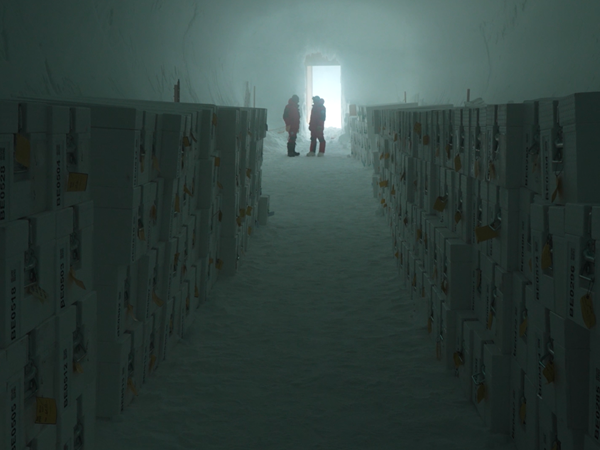
The storing of the very first heritage cores in Antarctica marks a pivotal moment for the Ice Memory project launched in 2015 by the National Research Council of Italy (CNR) and Ca’ Foscari University of Venice (Italy), with CNRS, IRD, the University of Grenoble-Alpes (France), and the Paul Scherrer Institute (Switzerland).
After a journey of more than fifty days aboard the Laura Bassi R/SV that began in Trieste (Italy), two precious ice cores from the endangered Alpine glaciers collected with the support of the Ice Memory Foundation have successfully arrived at the French-Italian Concordia Station, in the heart of the Antarctic Plateau. The transport was handled by the National Institute of Oceanography and Applied Geophysics (OGS), in the framework of the Italian National Antarctic Research Program (PNRA).
Upon arrival, the cores were stored inside the Ice Memory Sanctuary, an ice cave excavated specifically to serve as a natural, long-term repository of ice archives, officially inaugurated today. Within the framework of the UN Decade of Action for the Cryospheric Sciences, it clearly demonstrates the full feasibility of this effort to safeguard our planet's icy climate archives.
Trusting that advances in science and technology will unlock new scientific discoveries - even if the glaciers have disappeared - these ice cores represent a priceless legacy for future generations. They will provide a long-term resource for science and for evidence-based decision-making. As a time capsule, these ice cores contain the atmosphere of the past. They are now safeguarded for the decades and centuries to come, protected from any risk of loss.
From Europe to Antarctica: a historical journey to preserve climate archives
The two Alpine ice cores were extracted from Mont Blanc (Col du Dôme, France, 2016) and Grand Combin (Switzerland, 2025). The Grand Combin mission, coordinated by the Institute of Polar Sciences of the National Research Council of Italy (CNR-ISP) and Ca’ Foscari University of Venice, was supported by SEA BEYOND, a project of the Prada Group launched in 2019 in partnership with the Intergovernmental Oceanographic Commission of UNESCO, with the aim of raising awareness of ocean preservation and sustainability.
The two samples set sail in mid-October 2025 aboard the Italian icebreaker Laura Bassi, as part of the 41st campaign of the Italian National Antarctic Research Program (PNRA). Operated by the National Institute of Oceanography and Applied Geophysics (OGS), the 1.7-tonne cargo of ice was kept at a constant temperature of −20 °C / −4 °F for the entire journey. It crossed the Mediterranean Sea, the Atlantic Ocean, the Pacific Ocean, then the Southern Ocean and the Ross Sea before reaching Mario Zucchelli Station on 7 December 2025.
From there, a special flight made possible by the Italian National Agency for New Technologies, Energy and Sustainable Economic Development (ENEA) within the PNRA, and operated without heating in the cargo hold to ensure the integrity of the samples at −20 °C, transported the ice cores across the Antarctic interior to the Italo-French Concordia Station, at an altitude of 3,233 metres.
The Ice Memory Sanctuary: a natural infrastructure built in the heart of Antarctica
The Ice Memory Sanctuary - 35 meters long and 5 meters high and wide - is dug entirely into the compact snow layers about 5 meters below the surface, for a total of 9 meters depth. Under the technical coordination and design of the Antarctic Technical Unit of ENEA and with the collaboration of the French Polar Institute (IPEV), several tests were processed (from the 2018-2019 summer campaign) in order to provide the longest possible lifetime to the sanctuary, while limiting the impact of the construction on the Antarctic environment, in accordance with the Madrid Protocol. It required no construction materials, foundations or mechanical refrigeration. Its stability is ensured by the extreme and naturally constant Antarctic temperatures, which remain close to -52°C/-61°F year-round. The conditioning of the ice cores will ensure that the samples are protected from environmental fluctuations and contamination.
The initial environmental evaluation for this natural and low-impact ice cave was approved by the Antarctic Treaty System in 2024 (ATCM46), The sanctuary has been funded by the Prince Albert II Foundation, a historic philanthropic partner of the Ice Memory Foundation, and is one of the most innovative and remote scientific conservation facilities ever built.
"My foundation has been committed to the Ice Memory initiative since its genesis in 2015. We have a historic responsibility today to engage with Ice Memory to build up a heritage of glacial archives for our children." H.S.H Prince Albert II of Monaco, Honorary President of the Ice Memory Foundation.
A unique legacy as a response to the loss of the world’s glacial heritage
Mountain glaciers are retreating at unprecedented speed. Since 2000, glaciers have lost between 2% and 39% of their ice regionally and about 5% globally, threatening to erase centuries - and in some cases millennia - of irreplaceable and crucial scientific information, allowing scientists to observe and understand past trends and anticipate future ones.
For many decades, ice-core science has made unique contributions to political decision-making, particularly through the IPCC - Intergovernmental Panel on Climate Change. In response to the irreversible melting of the world’s glaciers, the Ice Memory Foundation has been identifying glaciers threatened with extinction and significant sites and has already coordinated, implemented, or supported 10 ice-core drillings worldwide since 2015, engaging scientific teams from over 13 nations (France, Switzerland, Italy, Tajikistan, Sweden, Japan, Norway, Brazil, Russia, China, United States, Bolivia, Norway) in this scientifically and globally significant initiative.
“By safeguarding physical samples of atmospheric gases, aerosols, pollutants and dust trapped in ice layers, the Ice Memory Foundation ensures that future generations of researchers will be able to study past climate conditions using technologies that may not yet exist” explains Carlo Barbante, vice chair of the Ice Memory Foundation, Professor at Ca’ Foscari University of Venice and senior associate member of CNR-ISP.
An international heritage under future global governance
Dozens of other Ice Memory heritage ice cores from all over the world - Andes, Pamir, Caucasus… - are expected to join these first two cores in their new home in the coming years. The Ice Memory heritage is conceived as a shared legacy of humanity.
Over the coming decade - designated as the UN Decade of Action for the Cryospheric Sciences - an international governance framework will be established to ensure that the heritage samples with their unique information remain accessible as a common lasting legacy for humanity. This governance will have to ensure transparent access to archived cores, based on scientific criteria only, managed on an ethical and equitable foundation.
“For these cores to serve science in a century's time, they must be managed as a global common. The creation of such a governance model would be a major achievement of the United Nations Decade of Action for the Cryospheric Sciences” said Thomas Stocker, University of Bern, Chair of the Ice Memory Foundation.
An urgent international call to action to the diplomatic and scientific communities
The Ice Memory Foundation and its partners are accelerating efforts to expand the collection and define an international governance framework. To achieve its ambitious roadmap (sampling 20 glaciers in 20 years), the Ice Memory Foundation calls upon the global scientific community, research institutions, decision makers and funding partners to act urgently to:
- organise and support new drilling campaigns on endangered glaciers,
- contribute to expanding the world’s long-term ice archive before these records disappear.
“We are the last generation who can act,” said Anne-Catherine Ohlmann, Director of the Ice Memory Foundation, “It’s a responsibility we all share. Saving these ice archives is not only a scientific responsibility—it is a legacy for humanity.”
Italian expeditions to Antarctica are funded by the Ministry of University and Research (MUR) and, within the framework of the PNRA, are managed by the National Research Council of Italy (CNR) for scientific coordination, by ENEA for the planning and logistical organisation of activities at the Antarctic bases, and by OGS for the technical and scientific management of the Laura Bassi.