Ca’ Foscari Secures 19 ‘Marie Curie’ Grants And Ranks Among Europe’s Top 10 Universities



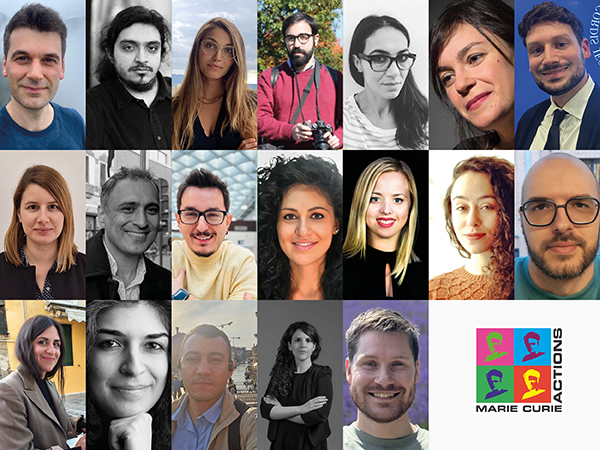
With 19 funded projects worth a total of €4.9 million, Ca' Foscari University of Venice once again ranks first in Italy and among the top 10 European universities for ‘Marie Skłodowska-Curie’ grants. Through the programme named after the first woman to win a Nobel Prize, the European Commission annually selects and funds the most promising talents, offering them the opportunity to carry out their own scientific project at a host institution of their choice in a country other than the one in which they are currently working. The ‘Marie Curie’ actions therefore promote the circulation of talent and the creation of new collaborations between universities and research bodies worldwide.
Competition was extremely intense: of 17,066 applications, only 1,606 (9.6%) were funded, resulting in an overall allocation of €404.3 million. Nearly 80 nationalities and 45 countries were involved. Italy ranks third for the number of successful proposals, with 174 grants, after the United Kingdom and Spain.
With the 19 newly awarded fellowships, Ca’ Foscari’s ‘Marie Curie’ community now numbers 240 fellows.
“We are greatly satisfied with these results,” said Tiziana Lippiello, Rector of Ca' Foscari University of Venice. “Our community will grow and be enriched by researchers developing their projects at Ca’ Foscari. We are delighted to offer growth opportunities to new scholars. This achievement confirms the attractiveness of our University in terms of both quality and international appeal.”
The researchers who have chosen Ca’ Foscari as their host institution represent ten nationalities (11 are Italian nationals and three hold dual foreign nationality). The foreign nationalities represented are: American, Brazilian, Canadian, Dutch, Egyptian, Iranian, Serbian, Slovenian, and Turkish.
GLOBAL FELLOWSHIP
Seven projects have been awarded a Global Fellowship. This type of grant funds up to two years at a host institution outside Europe, where fellows develop their skills and research before returning to Ca’ Foscari for a final year. The selected researchers are:
- Francesca Masiero, currently at the University of Verona and an adjunct professor at Ca’ Foscari, will study the cultural impact of medical and mathematical treatises, including incunabula and manuscripts produced in Italy between 1350 and 1600. Her research will take her to Harvard University and to Ireland, as part of the European Research Libraries consortium. Supervisor: Professor Eugenio Burgio, from the Department of Humanities
- Nicolò Ardenghi, currently at the Institute of Polar Sciences of the National Research Council (CNR), will seek to reconstruct past fires and climates by studying tropical and Siberian speleothems (such as stalactites and stalagmites). He will work at the University of São Paulo in Brazil and will also collaborate with the Brazilian National Observatory, the Max Planck Institute, and Northumbria University. He will be supervised by Professor Carlo Barbante of the Department of Environmental Sciences, Informatics and Statistics, and ERC grantee.
- Ilenia Pittui, an art historian at Ca’ Foscari, will examine Ottoman and Safavid iconography (1400-1762) from an interdisciplinary and transcultural perspective, as well as its dissemination across the Mediterranean. Her research will take her to the State University of New York at Buffalo in the United States and to the University of Vienna. She will be supervised by Professor Simone Cristoforetti of the Department of Asian and North African Studies.
- Giada Pellicari will analyse the role of women in European contemporary art by focusing on gallery owners and artists involved in Art Basel between 1970 and 1989, working at Yale University. Supervisor: Professor Stefania Portinari, Department of Humanities.
- Sakr Abdelmagid Basyouny, a linguist at Ca’ Foscari, will study the rhetoric of Islamic and Catholic institutions in relation to gender and equality policies, drawing on linguistic, religious and gender studies. He will work at the University of Toronto before returning to the Department of Humanities, where his supervisor is Professor Davide Mastrantonio.
- Caterina Borelli, an anthropologist at Ca’ Foscari and the recipient of her second Marie Curie fellowship, will explore what defines the concept of “home” in an age of precarity and uncertainty, conducting research in deprived neighbourhoods and refugee camps in Argentina and Italy. Her host institution abroad will be the Universidad Nacional de General Sarmiento (Argentina), and she will be supervised by Professor Valentina Bonifacio of the Department of Humanities, an ERC grantee.
- Mattia Fumagalli, currently at the Università Cattolica di Milano, will investigate how relations between Christians and Muslims, slavery and political pluralism influenced the formation and evolution of the state and social structures in the Horn of Africa from the eighteenth to the early twentieth century. He will work at Harvard University in the United States and, at Ca’ Foscari, will be supervised by Professor Matteo Legrenzi of the Department of Economics.
EUROPEAN FELLOWSHIP
European Fellowships fund two-year projects at a university in a European country other than the researcher’s country of origin. Among those joining Ca’ Foscari:
Isidora Grubački (Serbia/Slovenia) will arrive from the Slovenian Institute of Contemporary History to study anti-fascist women’s mobilisation in 1930s Europe, conducting archival research in the Czech Republic, France, Slovenia and the United Kingdom, and spending a research period at the Institute of Philosophy (CAS) in Prague and the INALCO in Paris. She will be supervised by Professor Chiara Bonfiglioli of the Department of Humanities, an ERC grantee.
Daphné Esquivel-Sada (Brazil/Canada), currently at the Université du Québec in Montreal, will examine how the idea of the human body as a multispecies biological system, in continuous exchange with the environment (as highlighted by the Human Genome Project), influences the way scientists conceptualise research, design experimental protocols and assess the socio-ethical implications of gut microbiome gene editing. She will be supervised by Professor Roberta Raffaetà of the Department of Philosophy and Cultural Heritage, an ERC grantee.
Emre Kaymakci (Turkey), from Niğde Ömer Halisdemir University, will investigate the socio-economic impacts of the Little Ice Age on Venice and Venetian Crete between 1453 and 1571. He will be supervised by Professor David Gentilcore of the Department of Humanities, an ERC grantee.
Francesca Bassani, currently at the École Polytechnique Fédérale de Lausanne (EPFL), will develop a global land-water basin model to predict carbon metabolism and cycle, incorporating hydroclimatic variability and land-river processes. She will be supervised by Professor Enrico Bertuzzo of the Department of Environmental Sciences, Informatics and Statistics.
Arash Azizi, Iranian-American, will arrive from Yale University (United States). He aims to produce the first integrated framework of Iran-Gulf-Israel relations, situating them within the transformations of the global order from the Cold War to today’s multipolar world. He will be supervised by Professor Matteo Legrenzi of the Department of Economics.
Jasmine Pisapia of the Institute for Cultural Inquiry in Berlin will study the “slow violence” of pollution and ecofeminist resistance in a community near Naples, using ethnography and collaborative artistic practices. She will be supervised by Professor Valentina Bonifacio of the Department of Humanities, an ERC grantee.
Timothy Tiggeloven, a Dutch researcher at Vrije Universiteit Amsterdam, will develop an integrated framework for multi-hazard early-warning systems, using AI and digital twins to model cascading effects and generate risk metrics to support resilience policies. The research will be conducted in collaboration with EURAC, Gifu University and CMCC. He will be supervised by Professor Andrea Critto of the Department of Environmental Sciences, Informatics and Statistics.
Elena Emma Sottilotta, from the University of Cambridge, will conduct a comparative study of the interplay between women and water in British and Italian fairy tales (1840-1910), combining ecocriticism and gender studies. She will be supervised by Professor Laura Tosi of the Department of Linguistics and Comparative Cultural Studies.
Miriam Pensack, American, currently at Princeton, will analyse the principle of “well-founded fear” in asylum law (1951/1967) through inter-American Cold War cases, using archives and oral history to rethink fear, security and protection criteria. Her supervisor will be Professor Vanni Pettinà of the Department of Linguistics and Comparative Cultural Studies.
Hamid Moein Ziaei, Canadian, will arrive from the University of Liège to study the theological and philosophical exchanges of Mughal India (1526-1858) through the still little-explored Zoroastrian corpus, offering a new perspective on interreligious interactions. He will be supervised by Professor Stefano Pellò of the Department of Asian and North African Studies.
Francesco Pisanu, from the Université Catholique de Louvain, aims to reconstruct the “genealogical tree” of bacteria, viruses and tumour cells more reliably and at scale, developing methods that yield verifiable results or guaranteed levels of accuracy. He will be supervised by Professor Raffaele Pesenti of the Venice School of Management.
Carlo Berardi, from the University of Michigan, will examine how the chivalric ideal adapted locally (as cultural “dialects”) and spread along maritime routes from Cyprus to Venice after the Fourth Crusade. He will be supervised by Professor Simone Piazza of the Department of Philosophy and Cultural Heritage.
The 2026 call will open on 9 April 2026 and close on 9 September 2026 (please follow updates on the dedicated webpage for the Marie Skłodowska-Curie Postdoctoral Fellowships).