
Where and who does heat hit hardest?



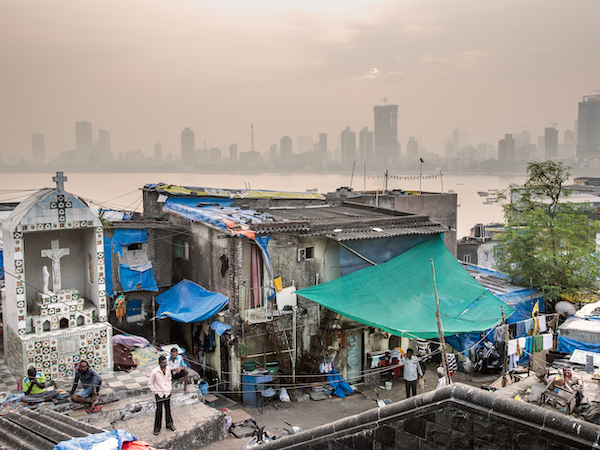
How do extreme and rising temperatures affect people around the world and how can we ensure that people are thermally safe? A new collaborative study between CMCC, University of Bristol and Ca’ Foscari University of Venice introduces the first multidimensional assessment of Systemic Cooling Poverty across 28 countries in the Global South, revealing how vulnerability to extreme heat is driven not only by climate but also factors such as infrastructure, inequality, health and work conditions.
Systemic Cooling Poverty describes situations in which people cannot stay thermally safe because of overlapping deprivations, from inadequate housing and lack of green and blue spaces to poor access to health care, protective measures and fair working conditions. Instead of focusing exclusively on common markers – such as access to air conditioning – the index looks at five dimensions: climate exposure, infrastructure and assets, social and thermal inequalities, health, and education and working standards.
“Systemic Cooling Poverty is a concept and navigation tool that helps organize the combination of conditions that lead individuals, organizations, or communities to encounter health risks, due not only to climate change and extreme heat, but also to a range of other infrastructural factors,” says co-author of the study Antonella Mazzone researcher at the University of Bristol and collaborator at CMCC and the Centre for Environmental Humanities (NICHE) of Ca’ Foscari University of Venice. Mazzone, who invented the Systemic Cooling Poverty concept, explains that vulnerability to extreme heat is not just a matter of income and energy poverty but rather about the intersection between climatic and socio-institutional factors.
Across the three billion individuals represented in the study's dataset, more than two thirds are found to be thermally unsafe in at least one dimension, and almost 600 million people live in regions with severe Systemic Cooling Poverty, facing multiple forms of deprivation at the same time. Going into more detail, education and working standards emerge as the prevalent driver, affecting around 2.2 billion people, followed by climate exposure, infrastructure and health.
“This shows that there are many factors that influence Systemic Cooling Poverty: transport, building materials, laws and regulations around work and exposure to heat, as well as access to services,” says CMCC researcher and lead author Giacomo Falchetta. “For example, a city in which everyone has air conditioning is not necessarily one in which there is no Systemic Cooling Poverty.”
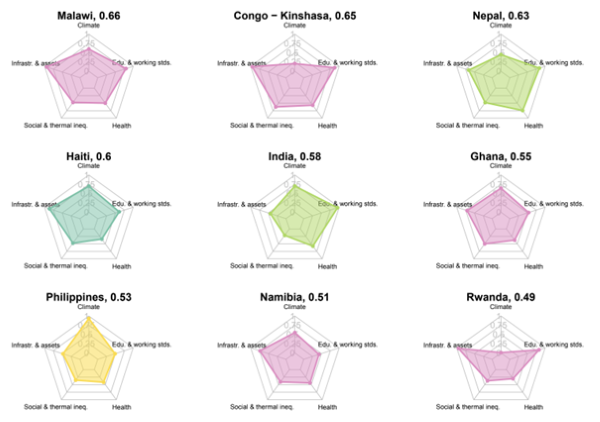
Heat risk is not determined by climate or income alone. Some structurally hot countries – such as Indonesia, Egypt and Jordan – record relatively low Systemic Cooling Poverty Index values because they perform better on non‑climatic dimensions like infrastructure and access to services. Others, including Ethiopia or the Democratic Republic of Congo, appear much more vulnerable despite milder average temperatures, due to deep infrastructural gaps and social inequalities.
“Among the countries covered by our assessment, Indonesia, Egypt and Jordan are among the countries with the lowest overall levels of Systemic Cooling Poverty […] whereas other countries that are not as exposed to extreme heat are less prepared [...] Systemic Cooling Poverty cannot just be reduced to an issue of income and climate as there are more complex risk factors,” says Enrica De Cian, researcher at CMCC, professor at Ca’ Foscari University of Venice and co-author for the study. Significantly, the study reveals only a weak linear correlation between national GDP per capita and Systemic Cooling Poverty, indicating that income alone is a poor proxy for systemic vulnerability to heat.
The framework developed by the researchers is designed as a tool that can help inform policy and planning: it can help identify which combinations of factors – for example, lack of green and blue spaces, inadequate housing materials, limited access to health services, or unsafe working conditions – are driving vulnerability in each context. For cities and local governments, this means being able to target measures where adaptation measures are most needed.
“This index could help direct planning at a local level, guiding multidimensional policies and planning including things like green or blue areas and access to them,” says contributing author and professor at Ca’ Foscari University of Venice, Gaia Bertarelli.
Concepts like thermal justice and systemic cooling poverty enrich the public and policy debate on energy and climate, moving beyond narrow notions of energy poverty to capture who is effectively protected from extreme heat and who is left behind.
Furthermore, this kind of study could also be applied to countries in the Global North where infrastructures and social perceptions of heat are very different yet systemic vulnerabilities are rapidly emerging.
For further information: A multidimensional assessment of Systemic Cooling Poverty in the Global South