Arab Mediterranean Campus concludes at Ca' Foscari: studying the environment strengthens a shared Mediterranean identity



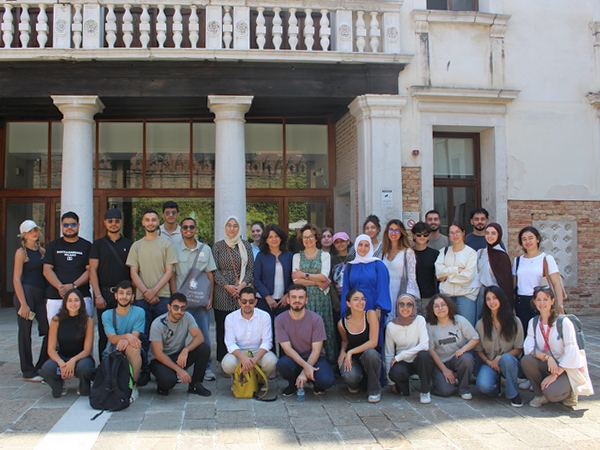
From 27 to 30 July 2026, Ca' Foscari University of Venice welcomed 27 students from countries across the Middle East and North Africa for an intensive academic programme as part of the Arab Mediterranean Campus (CAM). Funded by the Italian Ministry of University and Research, the initiative is coordinated by Luiss Guido Carli University in Rome and brings together a network of 12 Italian universities, including Ca' Foscari, alongside numerous partner universities in 18 countries across the MENA (Middle East and North Africa) region.
The CAM project aims to strengthen academic and scientific cooperation between Italy and the countries of the Middle East and North Africa through an Honors Program designed for undergraduate students enrolled at universities across the MENA region. Combining online teaching with in-person activities, the programme offers a multidisciplinary educational experience that equips participants to address both global and regional challenges facing the Mediterranean.
The second edition of the Honors Program, entitled Mediterranean Futures: Addressing Global Challenges, was jointly organised by Luiss and Ca' Foscari around the key themes of diplomacy and environmental sustainability. Following an intensive first week at Luiss in Rome, dedicated to Business Entrepreneurship and Legal-Political Development, the programme moved to Ca' Foscari in Venice, where it focused on Environmental Protection Challenges in the Mediterranean: Present and Future Perspectives.
The participants, all in the final year of their bachelor's degree programmes and selected on the basis of academic merit and motivation, came from leading universities across the MENA region: King Abdulaziz University (Saudi Arabia), Alexandria University (Egypt), Khalifa University (United Arab Emirates), American University of Beirut (Lebanon), Libyan International University and University of Benghazi (Libya), Mohammed VI Polytechnic University (Morocco), An-Najah National University and Birzeit University (Palestine), Damascus University (Syria), Tunis Business School (Tunisia), and Bahçeşehir University (Türkiye).
At Ca' Foscari, the programme was organised and scientifically coordinated by Professor Chiara Saccon, Vice-Rector for International Relations and International Cooperation, who commented: "Hosting the students of the Arab Mediterranean Campus at Ca' Foscari has been an experience of great academic and personal value. Through the scientific expertise of our academics in the fields of Mediterranean environmental protection, biodiversity and sustainability, we sought to make a meaningful contribution to the education of young people from ten countries across the MENA region. At the same time, these days have provided an extraordinary opportunity for intercultural dialogue, for exchanging different experiences and perspectives, and for building relationships that will endure over time. It is through initiatives like this that a stronger Mediterranean community can emerge, together with new forms of cooperation between universities, cultures and generations. I would also like to thank the Projects Unit of the International Office and the Ca' Foscari School for International Education for their excellent organisation."
The academic programme explored the major environmental challenges affecting the Mediterranean basin, including climate change, water resource management, marine pollution and biodiversity loss. Professor Antonio Marcomini delivered lectures on the evolution of human impacts on the Venetian Lagoon, European Union water policy, integrated water management and the analysis of major chemical pollutants. Professor Edy Fantinato and Professor Jalal Kassout (researcher at Morocco's National Institute for Agronomic Research – INRA) introduced participants to the ecological richness of the Mediterranean basin, the origins of regional crops, and strategies for conserving plant genetic resources and promoting sustainable agriculture in the face of climate change.
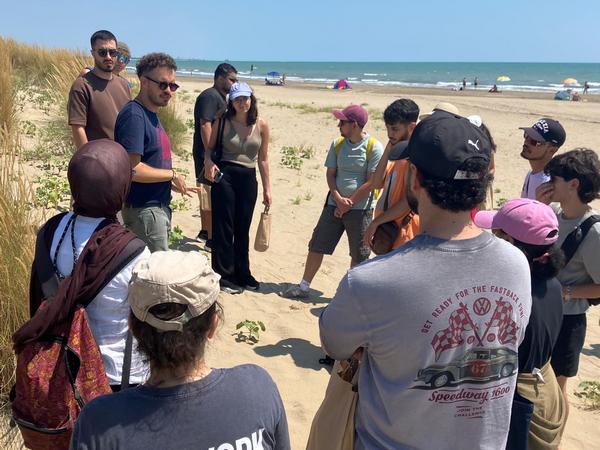
Alongside the lectures, the programme included a field trip to Punta Sabbioni (Cavallino-Treporti) to explore coastal habitats and dune ecosystems, as well as a visit to Ocean Space, a global centre dedicated to ocean awareness, research and conservation through the arts.
The initiative therefore provided participants not only with high-level academic training on the environmental challenges shaping the future of the Mediterranean, but also with a valuable opportunity to strengthen a shared sense of Mediterranean identity. "Today I define myself first and foremost as Mediterranean," one participant reflected. “Before taking part in this project, I used to describe myself as Arab and Muslim.”
Another student captured the unique atmosphere created during the two weeks of study and collaboration: "Two weeks, endless memories. Beyond the lectures, I found a real family across different cultures, sharing laughter, adventures and stories. Everyone brought their own unique spark – it was our differences that created the magic."