
Research sheds light on the ‘hidden’ history of Italian from the Middle Ages to the nineteenth century: Ca’ Foscari wins a €2.25 million ERC Grant for linguist Daniele Baglioni




The European Research Council (ERC) has announced that "ConScrIt – Concurring Scripts. Allography in Italy (1000–1800)", a project led by Professor Daniele Baglioni of the Department of Humanities at Ca’ Foscari University of Venice, has been awarded the prestigious ERC Advanced Grant under the 2025 call, which is one of Europe's most competitive funding schemes for frontier research.
This is the most prestigious research grant available in Europe, and marks Ca’ Foscari’s first ERC Advanced Grant since 2010.
With funding of €2.25 million, Professor Baglioni’s five-year project will bring together a team of seven researchers and doctoral candidates. Ca’ Foscari is one of 11 Italian public universities to receive funding in this round and the only one to secure an ERC Advanced Grant in the field of philological and literary studies. Overall, 19 Italian projects, hosted by universities and research organisations, have been selected for funding. The full list of successful projects is available here.
This year's call attracted a record 3,329 proposals, a 31% increase on last year's 2,534 submissions. Only 9.6% of applications were selected for funding.
The evaluation criteria are exceptionally demanding, assessing the scientific excellence of the principal investigator, the originality and transformative potential of the research idea, and the degree of risk inherent in pioneering frontier research.
The Award-Winning Project
Allography
The project investigates the practice, widespread in medieval and early modern Italy until the dawn of the modern age, of writing a language in a script not conventionally associated with it. Ethnic and religious minorities, for example, often used their own writing systems not only for their traditional languages but also to write local vernaculars and Italian.
This phenomenon is known as allography. Despite its remarkable prevalence and cultural significance, it has never been the subject of a comprehensive study.
Italy as a unique case study: the six scripts used to write Italian over the centuries
Texts, glosses, translations, poetic and literary works, dictionaries, love lyrics—including some of the earliest surviving attestations of the Italian vernaculars—make up an exceptionally rich and diverse corpus spanning eight centuries, from around 1000 to 1800, although most of the surviving material dates from the fourteenth to the sixteenth century.
In this field, Italy represents a truly unique case study. Nowhere else in Western Europe is there such a rich variety of allographic traditions. In addition to the Latin alphabet, Italian was written over the centuries in six different writing systems: Hebrew, Greek, Arabic, Armenian, Ethiopic and Syriac.
"This can be explained by several factors," says Professor Baglioni. "Italy's geographical position at the heart of the Mediterranean; the long-standing presence of ethnic, religious and linguistic minorities that, unlike in many other countries, were not expelled; the influence of the Italian maritime powers in the Levant and North Africa, which fostered contacts between different languages and scripts; and the role of the Church of Rome as the reference point for the Eastern Catholic Churches. This privileged vantage point allows us not only to compare different scripts and traditions but also to trace the entire 'life cycle' of allographic traditions, from their emergence and gradual establishment to their eventual decline. In other European countries with much larger allographic traditions, such as Spain, this final stage cannot be observed because the expulsion of Jews and Muslims at the end of the fifteenth century interrupted the gradual process of integration that ultimately rendered these practices obsolete."
An innovative approach combining Digital Humanities, linguistics and philology
The project adopts a pioneering cross-scriptal approach, bringing together linguistics and philology across multiple languages, supported by Digital Humanities methods. These include the automated transcription and transliteration into the Latin alphabet of a corpus of texts, among which the Venice Haggadah, in its Judeo-Italian version, is particularly significant. The project has also benefited from the valuable collaboration of the research team at the Venice Centre for Digital and Public Humanities within Ca’ Foscari's Department of Humanities.
"The project aims," Professor Baglioni continues, "to provide a theoretical framework for understanding the origins, development and decline of allographic traditions, as well as their functions; to establish a unified classification of the strategies used to adapt one writing system to a language usually written in another; and finally, to create the first thesaurus based on a cross-scriptal allographic corpus."
A new perspective on the history of the Italian language and culture
Allographic documents, especially the earliest ones, often preserve phonetic features and vocabulary that are absent from contemporary texts written in the Latin alphabet. This is largely because they are closer to spoken language: as these texts were written in scripts other than Latin, etymological spellings, Latinising forms and similar conventions were either very rare or entirely absent.
"Moreover," Professor Baglioni explains, "the allographic corpus includes some of the earliest surviving evidence of the Italian vernaculars. The oldest attestations of Sicilian and Sardinian are written in the Greek alphabet, while the earliest known evidence of the Salento variety appears in Hebrew characters. There are also fascinating examples of allographic texts written by foreigners, providing valuable evidence of what we would now call Italian as a second language. One remarkable case is a shipbuilding manual written in Venetian but using the Greek alphabet by a Greek author from the Venetian Outremer. It is among the most important sources for understanding how Greeks in the Renaissance likely spoke Venetian."
Beyond the history of the language itself, the allographic corpus also offers an extraordinary window onto Italy's cultural history. It includes literary works (especially poetry), translations of the Bible and the Gospels, dictionaries, scientific and philosophical treatises, sermons, prayers, nursery rhymes, charms and incantations. Because they were written in "other" scripts, these texts have largely remained on the margins of scholarly research.
"Dedicating a five-year project to these documents," Professor Baglioni concludes, "means bringing them out of the shadows, making them accessible to all, and ensuring they are no longer treated as second-class sources."
About Professor Daniele Baglioni
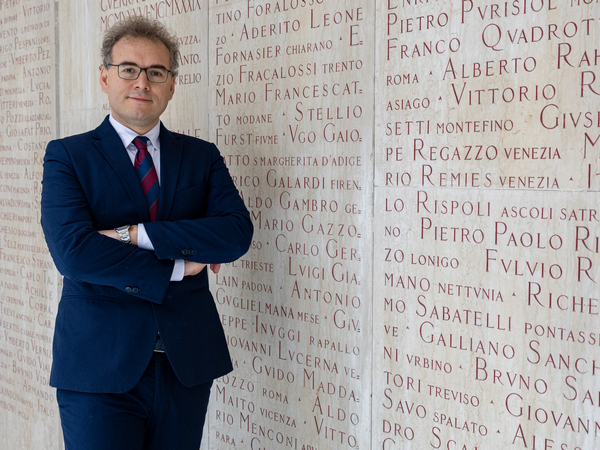
Professor Daniele Baglioni is Director of the Department of Humanities at Ca’ Foscari University of Venice and Full Professor of Italian Linguistics. He previously served as Coordinator of Ca’ Foscari's PhD Programme in Italian Studies. His research focuses on historical Italian linguistics, with particular emphasis on the etymology and historical phonetics of Italian and its dialects; the history of the Italian language beyond Italy; language contact between the Romance languages and other languages of the Mediterranean; the history of Italian and Romance linguistics and dialectology; and invented languages and imaginary grammars in Italian literature. He is the author of around 90 scholarly publications, including three monographs and four edited volumes. In 2004, he was awarded the CNR Research Promotion Prize, which funded the publication of his doctoral thesis. In 2009, he was also awarded funding through the FFABR (Fund for the Financing of Basic Research Activities).
The 2026 ERC Advanced Grant call is now open and applications can be submitted until 27 August. Further information is available on the Ca' Foscari ERC webpage