
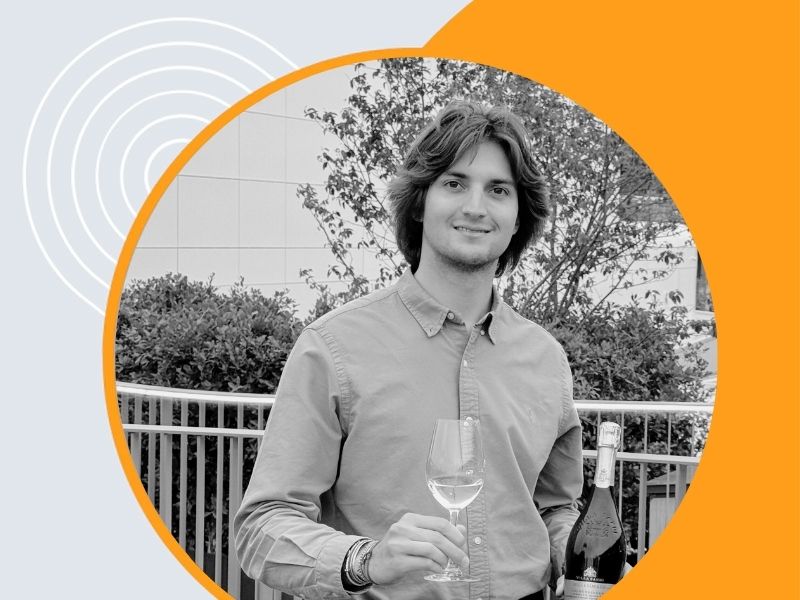
Leonardo Moretti Polegato, Villa Sandi
Curated by VSM Alumni, January 2026
Three keywords for innovation in a family business: understanding, method, responsibility
In the day-to-day life of a family business, there is rarely a precise moment in which “innovation happens.” Instead, there is a sequence of operational choices that, taken together over time, gradually change the way the organization works.
It is from this perspective that Leonardo Moretti Polegato, who holds a degree in Business Administration from Ca’ Foscari University and is currently Raw Materials Buyer at Villa Sandi and a Board Member of the Conegliano Valdobbiadene Prosecco Superiore DOCG Consortium, describes his professional path and his work at Villa Sandi, not as a series of innovations to be announced, but as a process structured around three keywords: understanding the business, the discipline of method, and taking responsibility for the consequences of decisions.
The first keyword is understanding: understanding the company’s history, the people who work within it, and the dynamics that hold it together. Without this understanding, any intervention risks being superficial or ineffective.
The second is method: reading data, comparing alternatives, structuring decisions, and dealing with uncertainty with discipline. Not as a purely technical exercise, but as a way to make change manageable and shareable.
The third is responsibility: because leading a family business means taking responsibility for decisions not only on an economic level, but also on a human and territorial one — towards people, the supply chain, and the broader context in which the company operates.
These three words — understanding, method, responsibility — were also at the center of the dialogue that took place on December 10th 2025 at the Venice School of Management, during the event “New Horizons of the Wine Industry: Trends, Challenges, International Markets and Innovation — A Dialogue with Villa Sandi,” organized within the Food Marketing course with Professor Christine Mauracher, in collaboration with the Agrifood Management & Innovation Lab of the Venice School of Management. On that occasion, we discussed these issues with Leonardo Moretti Polegato and with Villa Sandi’s Commercial Director, Flavio Geretto, focusing on how innovation is actually built in practice — beyond simplified narratives and within the everyday work of the company.
It is from these three keywords that this interview seeks to explore what it means to innovate in a family business today.
What led you to choose to study Management at Ca’ Foscari University, and how did that experience shape your view of business and leadership?
I came from a dynamic family business environment and I wanted to build my own tools, rather than simply entering the company “because that is what you do.” Ca’ Foscari taught me how to analyze, to question assumptions, and to make informed decisions. At Ca’ Foscari I understood that leadership is not an exercise of authority, but of responsibility: it means taking ownership of decisions, valuing the people around you, and creating the conditions for them to perform at their best.
Today you are part of one of the most dynamic wine companies in the country. Looking back, which aspects of your management education do you apply most in your daily work at Villa Sandi?
Every day I apply an analytical approach: reading numbers, comparing alternatives, assessing risk. It is a method that allows me to face challenges such as raw material shortages, changing markets, or shifting consumer preferences with clarity and discipline.
Entering an established family business means facing the challenge of adding value. What was your priority when you joined Villa Sandi, and how did you aim to make your personal contribution?
My priority was to understand the company deeply before trying to change it. I started by listening, observing, and spending time across different departments and operational areas. Only then did I begin to contribute in areas such as innovation, process digitalization, and the structuring of decision-making.
Leading a family business today also means reinterpreting it. How can innovation be built in a way that does not break with the past, but regenerates it?
Innovation is not a rupture, it is an evolutionary continuity. Innovation happens when you deeply understand your identity and translate it into a contemporary language. Our task is to regenerate the heritage we receive, not to replace it.
For Villa Sandi, sustainability is part of the company’s DNA, as is innovation — for example in your experimentation with no-alcohol wines. How do sustainability, changing consumption patterns, and entrepreneurial vision come together in your approach?
For us, sustainability is a long-term choice rooted in the territory, in people, and in the supply chain. But it is also a way of thinking about innovation: not as a change of identity, but as an evolution that is coherent with who we are.
When we work on new projects — such as no-alcohol — we do so by leveraging the skills, infrastructure, and know-how that are part of our production history. Innovation, for us, means starting from what we know best and using it to respond to new market needs, without chasing trends or solutions that do not belong to us.
In this way, sustainability, evolving consumption, and entrepreneurial vision naturally come together: the future grows from the foundations of tradition, not in opposition to it.
6. What advice would you give to students and alumni of the Venice School of Management who want to bring innovation into family businesses or traditional sectors?
My advice would be: do not rush to change things — first, take time to understand them. Innovation works when it is grounded in method rather than imposed, and when it is supported by data, analysis, and dialogue. And above all, when there is trust: before asking for it from others, you need to build it through your attitude, your presence, and your ability to listen. These are the foundations I consider essential for leading a family business and for bringing innovation into traditional sectors.
What emerges from this interview is not an abstract idea of innovation, but a concrete way of working within a company: understanding before acting, structuring decisions, and taking responsibility for their consequences. It is an approach that does not seek shortcuts or promise quick results, but aims to build changes that make sense for the organization and for the people who are part of it.
At a time when everything pushes towards speed and simplification, this perspective offers a useful counterpoint: it reminds us that not everything that changes quickly improves, and that the quality of change also depends on the time, care, and responsibility with which it is built.