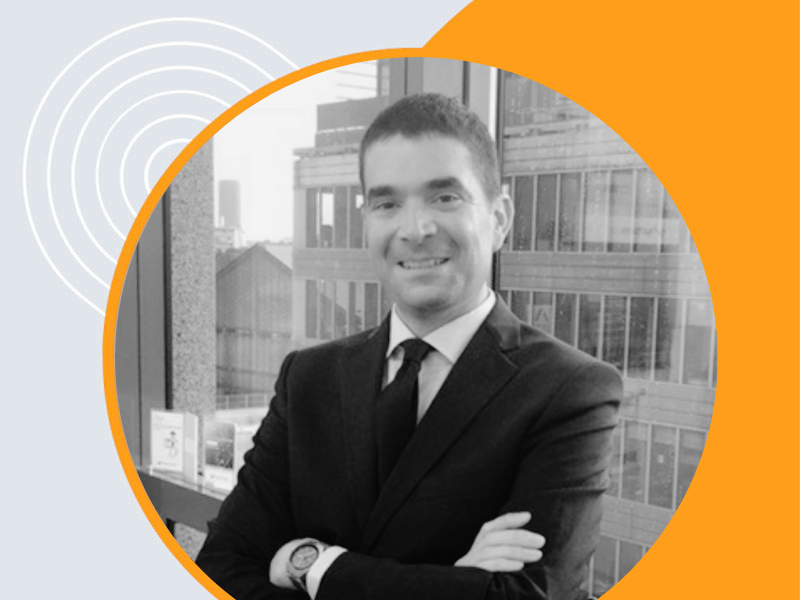
Massimo Grigolin, Natixis Investment Banking
A cura di VSM Alumni, dicembre 2025
A journey through financial markets and digital transformation
After graduating in Business Administration in Venice with a statistical–quantitative specialization, Massimo Grigolin built a successful international career in the Capital Markets across Italy, France, and the United Kingdom. The strong analytical background developed during his studies enabled him to enter the world of investment banking with solid technical foundations and a strong quantitative mindset.
After an initial experience in retail banking, choosing to pursue an MBA in Rotterdam opened the door to global and multicultural environments, which over time became the defining feature of his career path.
At Natixis, he has held roles covering the entire spectrum of markets: from credit to rates, from derivatives to securitizations, and ultimately the management of commercial teams operating in highly competitive environments. A keen observer of industry evolution, he has closely followed the digital transformation of the markets and the growing role of artificial intelligence in operational and decision-making processes.
Today, his strategic focus is on the new balance between traditional banks and private credit and equity funds in an increasingly disintermediated Europe, with particular attention to the intercultural and relational competencies required to lead global teams in a rapidly changing landscape.
How did your studies in Business Administration in Venice contribute to building your professional profile? Looking back, which skills acquired at university were truly useful in the world of investment banking?
I have to say that when I attended university, the environment was much more theoretical and less connected to the job market compared to what it is today. The skills students acquired were more oriented toward theoretical enrichment rather than practical application.
That said, by choosing the statistical–quantitative track, I developed strong foundations in statistical and quantitative analysis, which I could immediately apply in my work in investment banking, particularly in the markets division, where we deal with interest rates, credit spreads, FX, derivatives, and securitizations. These skills were essential to start my career.
At the same time, the competitive university environment—entry barriers, large classes, and limited resources—taught me how to work toward goals, build an effective network, and find quick and efficient learning methods. These skills helped me a lot when transitioning into the professional world, especially when I moved into commercial roles and later into sales team management.
What was the most challenging step between university and entering the world of investment banking? And how did you turn your academic knowledge into practical tools?
The most challenging step was definitely moving beyond a very local dynamic. I studied between Padua and Venice, and at that time English was still perceived as marginal. Entering an international environment was the real challenge.
After university, I worked briefly in retail banking at the old Credito Italiano in Padua, but I quickly realized that my real passion was investment banking and the markets, not retail.
To bridge the gap and gain the international exposure I was missing, I decided to pursue an MBA in Rotterdam. More than for the technical skills—which I had mostly gained during university—it was an essential experience for opening myself up to a global environment and learning how to operate in an international context, which later became the key to my entire career.
Digitalization is now crucial even in corporate banking. How do you experience digital transformation at Natixis, and which innovations have most improved operational efficiency?
The world of markets has been radically transformed by digitalization. When I started, every transaction—FX, interest rates, corporate bonds—was done over the phone with clients: you talked, agreed on terms, and executed the trade. Today, I’d say that 90% of this business goes through electronic platforms.
This has profoundly changed the role of salespeople: the more standardized, low value-added activity is handled by machines, while the human component remains fundamental for everything requiring advisory, relationships, and the ability to interpret the market. When most volumes are executed electronically, the sales role becomes essential in maintaining trust and adding value to the relationship—ensuring that clients remember you in key moments.
The second major transformation concerns artificial intelligence. Since we handle a huge amount of data and reports daily, AI makes it possible to extract relevant information very quickly, making our work far more efficient. Being able to upload complex documents and get the key sections in seconds is a real game changer, and I believe its impact will become increasingly central.
Looking ahead, which emerging trends do you think are redefining European corporate banking? How is your team preparing for these changes?
One of the most significant trends reshaping European corporate banking is the disintermediation of the banking system. Increasingly, non-bank institutions—especially private credit and private equity funds—are able to arrange large transactions quickly, without the need for syndicated lending among multiple banks. This makes them extremely effective in responding to clear and immediate financing needs, putting traditional banks at a disadvantage as they must go through longer processes such as credit committees or the creation of investor pools.
We see this phenomenon both on the corporate side—with large financial operations managed by funds—and on the retail side, with platforms that were born as peer-to-peer lending networks and then, growing, began accessing capital markets for funding.
The challenge for us, as a corporate and investment bank, is to understand what role we can play in this new paradigm. The new objective is to figure out how to collaborate with private credit funds, private equity funds, and the various non-bank lenders. With my team, we are working to position ourselves precisely on this, trying to structure tailor-made solutions. That’s where we can still make a difference.
You are now an established manager in an international group. Which soft skills do you consider essential for someone graduating in business administration who wants to grow in a competitive, multicultural environment like Natixis?
In my view, the most important soft skill in an international context is not just speaking the language, but understanding and interpreting the culture of the people you work with. In my case, working within a French bank deeply rooted in its country but with a global presence, it was essential to learn how to navigate the dynamics typical of a French institution without losing sight of the multicultural context in which we operate.
I also spent several years in England with Natixis, and there I experienced firsthand how crucial it is to translate not only the language but also the mindset and way of working: explaining to a major Anglo-Saxon investor how a French organization works, and vice versa. They are two very different worlds, and being able to act as a bridge between them is a decisive skill.
To this, I would add the ability to work toward clear objectives and never lose sight of the final result: whether it’s a negotiation or a commercial relationship, knowing your goals and adapting your communication and working style to the cultural context truly makes the difference.
What advice would you give a VSM student interested in pursuing a career in investment banking, especially in a Franco-Italian context like yours?
My advice is to gain hands-on experience as soon as possible in a bank that does serious investment banking. It doesn’t matter whether it’s in Milan, London, Paris, or New York: what matters is stepping outside your comfort zone and experiencing a real, competitive environment.
In Italy, most investment banking activity is concentrated in Milan, and that’s where you need to challenge yourself.
Students shouldn’t feel inferior to graduates from Bocconi or Luiss: Ca’ Foscari provides excellent preparation, but it’s essential to build the right network, learn how to navigate an international environment, and understand that—beyond technical skills—relationship-building and seizing opportunities are crucial.
Looking at the Anglo-Saxon model can be helpful: less theory and more real business cases, contact with companies, practical problem-solving, networking. In short, don’t settle for a comfortable experience close to home—aim straight for an internship in a major investment bank. It may be tough—you may end up living in a small room with a tight budget—but that experience truly shapes you and opens the doors to your future career.
Massimo Grigolin’s international experience is a concrete example of how solid technical skills, a global outlook, and strong relational abilities can come together to build a successful career in financial markets. His story offers valuable insight into a sector undergoing constant transformation, driven by digitalization, the growing impact of artificial intelligence, and the rise of private credit and private equity funds in an increasingly disintermediated Europe.
His career shows how a rigorous academic foundation—combined with the courage to step outside one’s comfort zone—can open meaningful professional opportunities. His experience highlights the importance of cultivating an open, curious, and innovation-oriented mindset: an essential approach for navigating a rapidly changing sector that increasingly demands new, transversal, and international skills.