

Ecohydrology
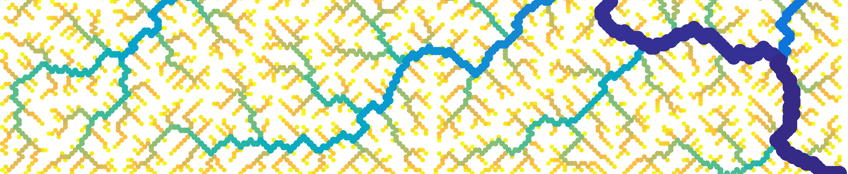
The laboratory studies ecohydrology, a discipline that deals with the interactions between hydrology and ecology. Specifically, the Lab studies hydrological controls on fluvial biodiversity, population dynamics, bio-geochemical cycles and water related diseased. Theoretical, modelling and experimental approaches are developed. The main research topics are:
- Fluvial metabolism;
- Carbon cycle on watersheds and river networks;
- Biodiversity and species interaction models in river network and salt-marshes;
- Modelling of water related diseases;Hydrologic modelling and flood forecasting.
Collaborations
Publications
- Enrico Bertuzzo, Damiano Pasetto: The geography of COVID-19 spread in Italy and implications for the relaxation of confinement measures NATURE COMMUNICATIONS, vol. 11 (2020)
- Enrico Bertuzzo: The Metabolic Regimes at the Scale of an Entire Stream Network Unveiled Through Sensor Data and Machine Learning ECOSYSTEMS (2021)
- Elisa Stella, Jacopo Gabrieli, Carlo Barbante, Enrico Bertuzzo: Mapping environmental suitability for anthrax reemergence in the Arctic ENVIRONMENTAL RESEARCH LETTERS, vol.16 (2021)
- Enrico Bertuzzo: Scaling of dissolved organic carbon removal in river networks ADVANCES IN WATER RESOURCES, vol.110 (2017)
- Enrico Bertuzzo: Unexpected large evasion fluxes of carbon dioxide from turbulent streams draining the world’s mountains NATURE COMMUNICATIONS, vol.10 (2019)
Case studies
- Metabolismo fluviale e stime di emissione di anidride carbonica dai fiumi
- pubblicazioni:
The Metabolic Regimes at the Scale of an Entire Stream Network Unveiled Through Sensor Data and Machine Learning
Modeling the coupled dynamics of stream metabolism and microbial biomass
Climate-Induced Changes in Spring Snowmelt Impact Ecosystem Metabolism and Carbon Fluxes in an Alpine Stream Network
Unexpected large evasion fluxes of carbon dioxide from turbulent streams draining the world’s mountains - rassegna stampa:
Il respiro dei torrenti montani: emettono 30% della CO2 fluviale [ITA]
- pubblicazioni:
- Impatto delle barriere mobili sulla geomorfologia della laguna di Venezia e sugli ecosistemi barenicoli
- Sviluppo di modelli per la previsione dell’evoluzione dell’epidemia COVID-19 in Italia
- pubblicazioni:
The epidemicity index of recurrent SARS-CoV-2 infections
Range of reproduction number estimates for COVID-19 spread
The geography of COVID-19 spread in Italy and implications for the relaxation of confinement measures
Spread and dynamics of the COVID-19 epidemic in Italy: Effects of emergency containment measures - rassegna stampa:
Decreti Covid-19: in marzo evitati almeno 200mila ricoveri [ITA]
Isolare i casi per frenare Covid-19, studio su Nature Communications [ITA]
- pubblicazioni:
Research projects
- EPIDOC, Data assimilation of epidemiological data and the optimal control for the short term forecast and management of COVID-19, Fondo Integrativo per la Ricerca (FISR 2020), Italian Ministry of University and Research
- NewTechAqua, Tools and Strategies for a Sustainable, Resilient and Innovative European Aquaculture, Horizon 2020 European framework
- Smart solutions for the monitoring pollutants and environmental impact of highway runoff, European Social Fund, Veneto Region
- Venezia 2021, Research program for a regulated lagoon (http://www.corila.it/it/Venezia2021), Linea 3.2, Consorzio Ricerche Lagunari
- EUROFLOW, A EUROpean training and research network for environmental FLOW management in river basins, Role: Partner. Marie Skłodowska-Curie Action: European Training Network
- Cholera spreading and migration fluxes around lake Chad: The Niger case study. UNICEF Niger
- SMIRES: Science and Management of Intermittent Rivers & Ephemeral Stream, COST-action, European Cooperation in Science and Technologies
- Nunataryuk, Permafrost thaw and the changing arctic coast: science for socio-economic adaptation, Horizon 2020 European framework