
Welcome Back to San Sebastiano: Ca’ Foscari’s Revitalised Hub for Oriental Studies



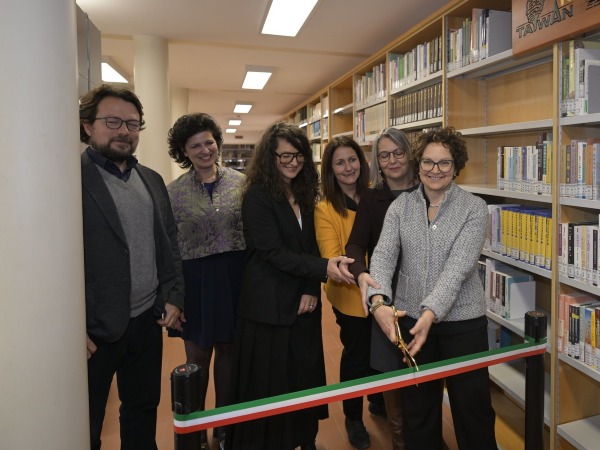
Following the completion of a major redevelopment project, the Ca’ Foscari San Sebastiano site was officially inaugurated on Wednesday, 26 November 2025 and is now ready to welcome students, faculty, and staff.
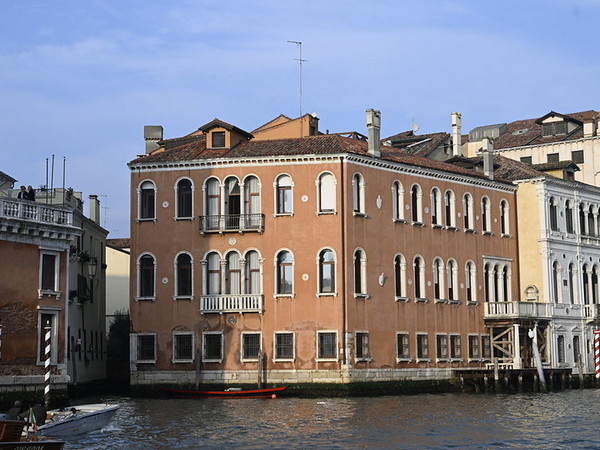
The symbolic ribbon cutting by Rector Tiziana Lippiello marks a new beginning for one of Ca’ Foscari’s historic buildings, characterised by its monumental entrance designed by Carlo Scarpa. From now on, this will be the heart of Oriental Studies and a strategic hub for languages, well integrated into the broader network of university and city spaces.
San Sebastiano is now home to the East Asia collections of the Library of Foreign Languages and Literatures (BALI) and to part of the Department of Asian and North African Studies, previously housed in Palazzo Vendramin dei Carmini.
Rector Tiziana Lippiello commented: “Completing this project has been truly significant for us—not only in terms of our strategic goals of redeveloping and reorganising our sites, but also for its symbolic value. The San Sebastiano site is a prestigious part of the history of Ca’ Foscari, as well as the history and architecture of our city, Venice. The exquisite entrance designed by Carlo Scarpa, the garden, and the Aula Colonne are iconic features that make this place genuinely special. We are very pleased to have preserved and enhanced it, with spaces that are now more accessible, functional, and welcoming.”
Speakers at the inauguration also included Paola Mar, Councillor for Universities of the City of Venice; Laura De Giorgi, Director of the Department of Asian and North African Studies; Marina Buzzoni, Chair of the University Library Service and Rector’s Delegate for the University Library System; Natascia Danieli, Director of the Library of Foreign Languages and Literatures; Jacopo Fusaro, Director of the Building Maintenance Office and Single Point of Responsibility; Cristina Massironi, Support to the Single Point of Responsibility; and Alice Gruarin from the Furniture Supplies Unit of the Real Estate and Building Services Area.
Browse photos of the ceremony on Flickr.
 Flickr
BALI – Library of Foreign Languages and Literatures
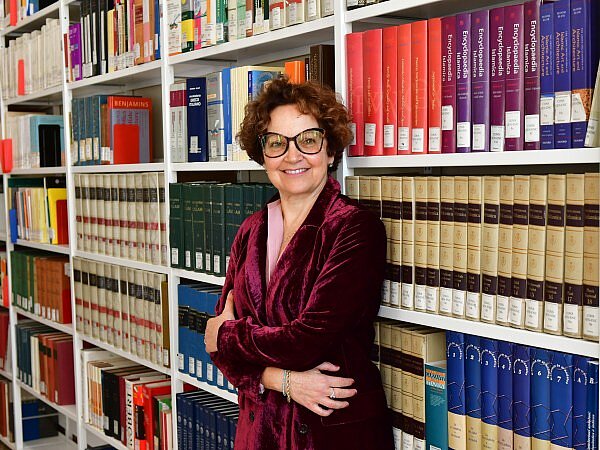
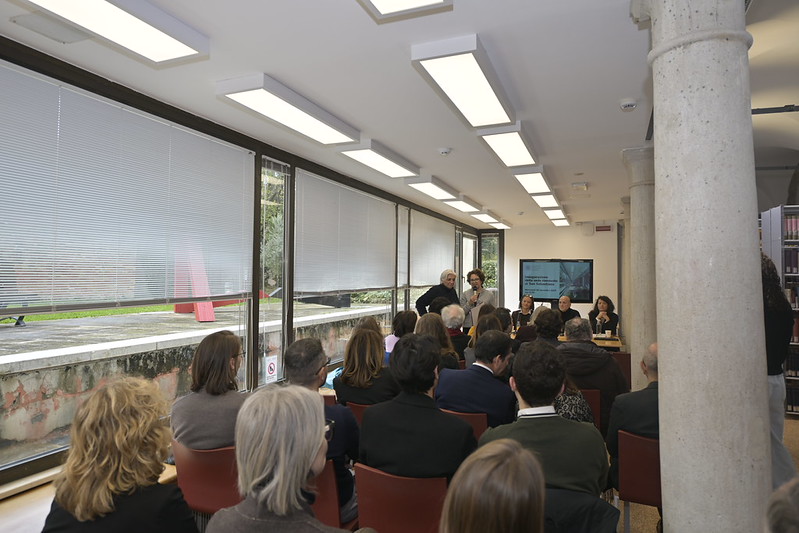
The BALI Library – East Asian Studies section has been designed with a modern, functional approach to library services, collections, and spaces. Notable for its large, welcoming internal garden, the new premises are accessible and provide 112 seats (a 7% increase).
The collections, previously located in Palazzo Vendramin, consist of approximately 35,000 volumes—many rare and valuable—covering East Asian countries: Japan, China, Korea, Southeast Asia, and Taiwan. These regions are now properly showcased in the new library with open-shelf access. The volumes, many of which are in the original languages, are spread across two floors.
The materials most frequently used for teaching and language study are located on the ground floor, in the Colonne-Ruperti Room, a spacious, well-lit area ideal for reading.
On the first floor, users can explore the open stacks arranged by geographical area and various fields of study and research, with study stations and shelving alternating dynamically across two spacious, functional reading rooms.
One example of the library’s valuable holdings is from the Japanese and Chinese seminar collections, which formed the initial core of the East Asian Studies Library—such as the Histoire du Japon in the 1754 Paris edition. The BALI collections have also been expanded and enriched over time through donations from foundations, universities, and national libraries, as well as private gifts from former faculty and specialists, including the Boscaro, Cagnoni, Canova, Esposito, Gatti, and Guerrini collections.
AOlab has also been established as the first BALI space available for collaborative and interactive group study, workshops, and cross-disciplinary laboratory activities. In addition to housing the library’s most valuable collections, it offers 12 seats around a single table, and a computer workstation that can also be used for bibliographic consultations.
Department of Asian and North African Studies
The San Sebastiano site also hosts activities of the Department of Asian and North African Studies (DSAAM) that were previously based at Ca’ Vendramin. It provides 66 workstations for faculty, 12 for collaborators and language experts, and 21 for administrative staff, along with a common room on the ground floor.
The Department has a longstanding tradition of scholarship and research in Oriental studies, developed at Ca’ Foscari since its earliest days (Japanese has been taught at the Venetian university since 1873). Here, students can study the languages and cultures of a vast region stretching from North Africa to East Asia. The languages offered include: Arabic, Hebrew, Turkish, Armenian, Persian, Hindi, Sanskrit, Vietnamese, Thai, Mongolian, Chinese, Japanese and Korean.
The reopening of San Sebastiano marks an important milestone for Ca’ Foscari, safeguarding and enhancing teaching and research activities in the field of languages at a location already crucial to the University. With newly revitalised spaces that are more comfortable, practical, and inviting, the building is poised to become a vital reference point for the entire university community.