
From Church to University Library: Ca' Foscari Opens a New Chapter at Spirito Santo




The transformation of the Church of Spirito Santo on Fondamenta delle Zattere in Venice into a University Library has begun. The project has been approved by the Academic Senate, the Board of Directors, and the Assembly of Student Representatives.
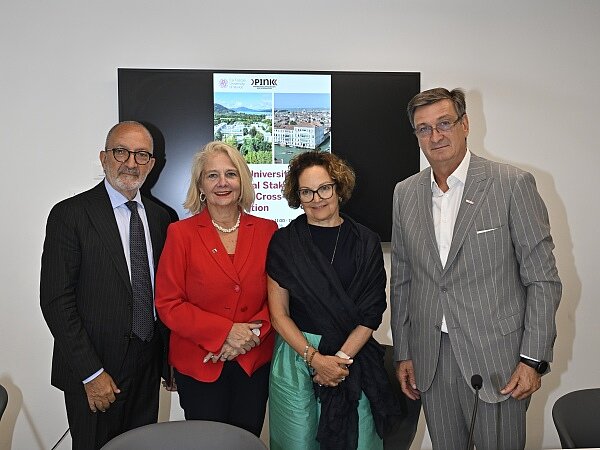
Today, Tuesday 16 December 2025, Rector Tiziana Lippiello and the Patriarch of Venice, Monsignor Francesco Moraglia, signed the addendum to the 2024 Memorandum of Understanding, establishing that the real right of use of the property will commence by 30 September 2026.
The church – closed for over twenty years – will be transformed into a space dedicated to study and research for Ca’ Foscari students and researchers. It will also be accessible to the wider Venetian academic and student community and the public.
The library will be arranged within a structure built at the centre of the nave, featuring staircases and a lift, and will span three levels. It will contain around 2,000 metres of books and offer a total of 290 study seats.
The Project: a Library and a Space for Public Outreach
The project will feature a multi-storey vertical structure at the centre of the nave. The four levels of this installation will include perimeter galleries, providing access to the books and unobstructed views of the altars and the monument on the counter-façade, thereby maintaining the original visual perception of the church. Access is facilitated by an integrated staircase and lift, ensuring accessibility for anyone with reduced mobility.
A dedicated space is also planned for activities related to the University’s Third Mission and the enhancement of knowledge. The new library will be integrated into the Venetian cultural hub that includes the Academy of Fine Arts, the Guggenheim Museum, Punta della Dogana, and the Cini Foundation. It will be easily accessible owing to the nearby vaporetto stop, also called Spirito Santo.
Rector Tiziana Lippiello stated: “The new University Library becomes a place that reflects Ca’ Foscari’s vision for Venice and its commitment to giving the city a vibrant centre for the enhancement of knowledge and services for students - a new hub for university research and a support to all teaching activities. Ca’ Foscari will make a significant contribution to the life of Venice through an innovative restoration and adaptive reuse of a disused historic building.”
Monsignor Francesco Moraglia, Patriarch of Venice, commented: “The agreement for establishing a university library in the former Church of Spirito Santo at Zattere is part of the Patriarchate of Venice’s efforts to open or reopen numerous churches in the historic centre free of charge and without entrance fees. For other churches, there is an overarching project aimed at preserving places of worship, recognising their religious significance as sites of culture, catechesis, and art. The agreement we have entered with Ca’ Foscari for the Church of Spirito Santo also aligns with the broader and more enduring institutional relationship between the Church of Venice, the city’s universities, and other Venetian cultural institutions.”
Overall, the project aims to repurpose existing, historical structures within the urban fabric. Through a process of transformation and innovation, these places will acquire a new international and contemporary identity while staying closely linked to Venice’s historical and artistic tradition. The adaptive reuse of the Church of Spirito Santo will also allow for a deeper exploration of its historical and artistic significance, such as enhancing knowledge of its Rococo stuccoes, a fine example of the work by a renowned scuola from Ticino, active in eighteenth-century Venice.
The estimated investment for the project is around €10.5 million, spread over a minimum of 30 years.
History of the Church
The Church of Spirito Santo, located along Fondamenta delle Zattere, was founded towards the end of the fifteenth century for the use of the Augustinian convent built around the same period in the area behind it.
The current building resulted from a reconstruction undertaken in the early decades of the sixteenth century.
Closed since the period of the Napoleonic suppressions, the church houses monumental riches, comprising Renaissance and Baroque artworks (marbles, wooden sculptures, stuccoes, and altarpieces). Among the most notable are:
a large panel painting used as an altarpiece, depicting the Saviour between Saints George and Liberale, by Giovanni Buonconsiglio, known as il Marescalco (c. 1465-1537);
a large canvas altarpiece depicting The Marriage of the Virgin, by Palma il Giovane (1544-1628);
a funerary monument attributed to Baldassarre Longhena (c. 1596-1682), the architect and sculptor renowned for designing the Church of Santa Maria della Salute;
Rococo stuccoes by the scuola of the Swiss artist Abbondio Stazio (1663-1757).