
An Endless Nakba: An Interview with Francesca Albanese



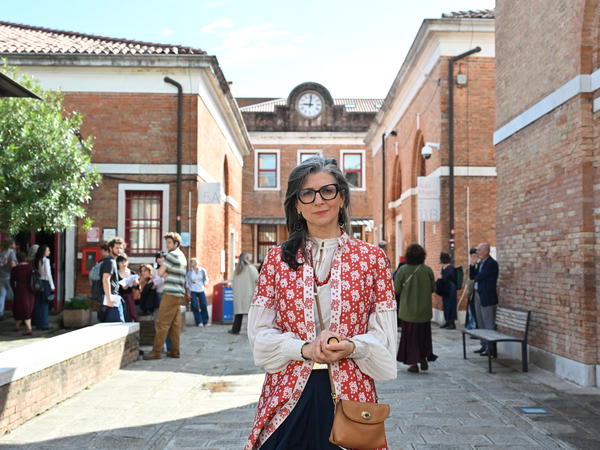
“We are not facing a historical event that has ended, but an ongoing process.” With these words, Francesca Albanese, the UN Special Rapporteur on the occupied Palestinian territories, opened her talk at Ca' Foscari University of Venice's San Giobbe Campus on 11 May.
The event, entitled An Endless Nakba. Economy and Violated Rights in Palestine, opened with institutional greetings from Anna Comacchio, Director of the Venice School of Management, and was moderated by Francesco Vacchiano, Ca’ Foscari’s Delegate for International Cooperation and Simone Sibilio, Professor of Arabic Language and Literature at the Department of Asian and North African Studies. Before a packed Aula Magna Cazzavillan, Albanese presented an analysis of her most recent reports (2025–2026), exploring the economics of genocide and systematic torture. Inviting students and academic staff to “look at the world through the eyes of future generations”, Albanese reiterated the urgency of returning to international law as the only possible framework for political action.
On a quiet campus bench before the conference started, we had the pleasure of meeting Francesca Albanese and asking her a few questions.
Today, we often see an instrumental, almost ‘à la carte’, use of international law to justify political or military aims. In this context of humanitarian ‘camouflage’, how urgent is it to reaffirm its importance and rigour?
International law plays a fundamental role: had it been respected, and had human rights, the Geneva Conventions, and the Conventions on the Prevention of Genocide and Apartheid been upheld, we would not be in this situation today. There is therefore an inseparable link between the rigorous application of the law and the necessary end of the cycle of impunity. At a moment like this, when there is a tendency to forget that law is the natural framework of political action, every citizen is called upon to develop a profound awareness: today the choice is between the rule of law and the barbarity of the law of the strongest. If the law applies only up to a certain point, it inevitably ends up applying to some people and not to others, including in the Italian context. I believe that, when placed before the famous “veil of ignorance”, everyone would have an interest in living in a society where the law is fully applied, supported by a strong and protective Constitution such as ours.
At Ca’ Foscari, languages, economics and international relations converge. Drawing on your experience as a jurist and UN Rapporteur, which aspect of your education is most valuable today for navigating complex international contexts?
I believe the fundamental “building block” lies in civic consciousness and in knowledge and understanding of the past: from Italian history of Independence to the anti-fascist movement, through to the end of the regime and democratic resistance during the years of terrorism. It is a dense history, encompassing the fight against the mafia and other organised criminal groups — the Camorra and the ’Ndrangheta — as well as the battles still being fought today by citizens and workers in the so-called “expendable zones”, from the Terra dei Fuochi to the Ilva steelworks in Taranto. This is the foundation of my own development, which has grown stronger alongside an awareness of all the expendable zones and shadow zones in our collective memory.
What happens in Italy has echoes in the international community, where areas of profound injustice turn law into a tool in the hands of a few “predators”, to quote the powerful definition used in the latest annual report by Amnesty International. I believe Palestine is both the wound and the moral compass of our time; it reveals the existence of a common enemy, which, however uncomfortable the statement may be, is not a single State but an entire system. It is an apparatus that arms Israel, providing advanced technologies to carry out a genocide which it then defends, conceals and profits from, actively enriching itself in the process. This is what I call necro-capitalism: the true enemy of humanity. It is an evolution of the capitalist system, born three centuries ago and expanded globally through colonialism. Although we were told that settler colonialism had ended and that we lived in a democracy of equals among individuals and States, today’s reality disproves that narrative. In this sense, Palestine functions as a portal between the present and the future, but above all as a mirror for all of us.
Let us look behind the scenes of your work: how do you design a field investigation that is both technically rigorous and humanly authentic? What are the most difficult challenges — diplomatic, technical, and everyday — that you encounter?
What comes first is a detailed yet detached observation of reality. Each of us, for professional reasons, tends to have specific inclinations: from the very beginning of my mandate, for example, I felt an urgent need to focus on detention. This commitment took shape in my second report as Special Rapporteur, which examined torture as the architecture of settler colonialism and focused on the conditions of detained Palestinians, particularly minors, a subject to which I also devoted my third report.
However, there was one issue that frightened me and for which none of us was fully prepared: genocide. It “fell upon me”, forcing me to rapidly update my entire analytical framework and conduct even more meticulous field research. The most difficult challenge, in fact, remains documenting and drafting a scientifically robust report where documentation itself is obstructed or absent.
This was the first truly complex report I wrote, a work that required piecing together an extremely fragmented mosaic of facts. To achieve this, I relied on an extraordinary network of informants, from NGOs to the contribution of Forensic Architecture, who were with me yesterday in Venice for an event at La Biennale, and who conducted detailed technical investigations into how torture occurs not only inside cells but is embedded in the very architecture of the occupied territories. It was a collective effort involving many people, including former Israeli soldiers who chose to help us. However, the analysis itself was mine, validated and discussed with many genocide experts, including survivors, historians and anthropologists such as Nicola Perugini, who teaches in Edinburgh and has always provided a testing ground for my investigations.
The investigation into the economics of genocide was the most difficult inquiry I have ever conducted. It arose from an urgent necessity that pushed me beyond the boundaries of my usual expertise and forced me to “take a leap into the unknown”. Although I had never previously worked on corporate matters, I had to address the issue not as a matter of commercial law, but through the lens of international law. The aim was to expose the crimes and evasive strategies adopted by the business world to avoid responsibility.
My method rests on three pillars: the objective reconstruction of facts, field verification and legal analysis, followed by dialogue with the parties involved, namely the State of Israel and the Palestinian authorities. Although the Israeli authorities receive the analyses in advance — precisely to allow them to flag factual errors or interpretative disagreements — they have never addressed the substance, preferring instead to attack me systematically only after the report’s publication.
Following the sanctions imposed on you by the United States, which have profoundly affected your professional and personal life, and in light of the recent honour you received from Spanish Prime Minister Sánchez, were you surprised by the lack of support from your own government and from European institutions more broadly?
I would like it to be clear that what truly shattered my life was the genocide itself: for me, it represented a rupture in the very conception of the world and society. On the one hand, I had to witness the impunity granted to Israel and the passivity — if not outright complicity — of many governments, including that of our own country. On the other hand, I witnessed the tireless commitment of countless individuals and professional groups, from teachers to the dockworkers of Genoa, from grassroots trade unions to firefighters. A mobilisation of individuals, of mothers and fathers, emerged.
Clearly, the sanctions came as a devastating blow, following a very precise pattern: first they ignore you, then they ridicule and defame you; finally, when your message and actions become truly effective and therefore “dangerous”, they resort to direct punishment.
What message would you share today with the student movement and, more broadly, with young people defending Palestinian rights, who now face the risk of their actions being sanctioned as anti-Jewish hatred or antisemitism?
I would like them to reclaim the history of antisemitism, as it is an integral part of our identity. It is essential to understand that the Holocaust — the most tragic crime ever committed on European soil, and one that deeply involved Italy — originated in a deliberate process of dehumanisation. It began with the denial of others’ rights and the refusal to recognise their individuality, reducing them instead to a faceless, collectively guilty mass. This is the seed of racism and every form of discrimination, whether ethnic, religious or gender-based; and it is crucial to recognise that this very mechanism is the common thread running through every genocide in history.
Seeing young people protest against genocide today gives me hope and relief. Everything I do in Italy is directed above all towards them, so they know they are the healthy and sensible antibodies of a sick society, and that they are not alone. Israel would never have become what it is today without the impunity it has long enjoyed, guaranteed over time by governments, political systems and cultural institutions, including universities. For this reason, it is essential that young people recognise they stand on the right side of history. Today, in defending the Palestinian people and supporting those Israelis who oppose genocide, apartheid and permanent occupation, the same courage lives on as that shown by those who, in the 1930s, fought to protect Jewish people. Compared with that time, many more people today are standing up in defence of the vulnerable group; this does them honour, and I hope they will find the strength to persevere, because the future of all of us depends precisely on their commitment.