Behind the Scenes of La Fenice Theatre in Venice
Bachelor's Degree: Business Administration and Management
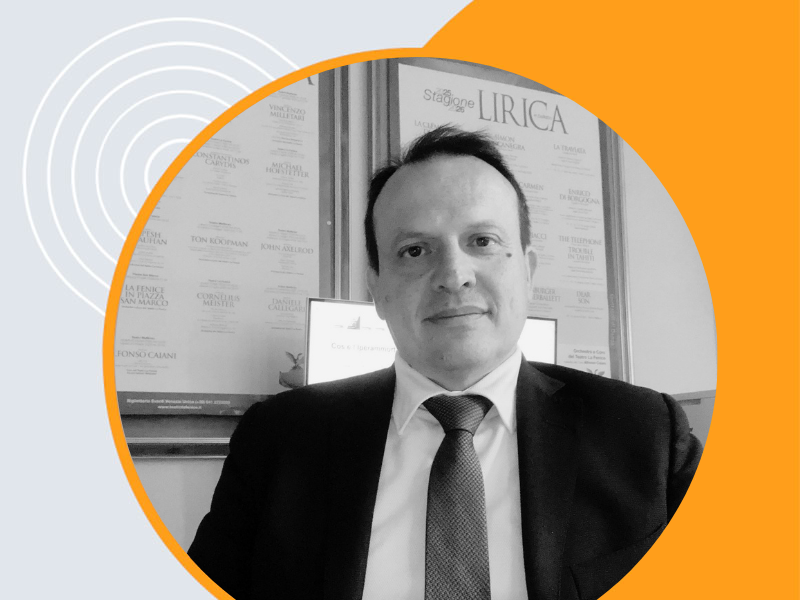
When people think of Teatro La Fenice, their minds immediately go to the stage, the voices, the music. Yet behind every opera performance, every concert, every show, there is a complex organization — or rather, as Giorgio Amata explains, four organizations coexisting and constantly interacting: the choir, the orchestra, the administrative staff, and the technical teams. Bringing all these worlds together has been his job for almost fifteen years.
A graduate in Business Administration and Management from what is now the Venice School of Management at Ca’ Foscari University of Venice, Giorgio Amata joined La Fenice in 2011 as Director of Human Resources and Organizational Development, after a professional journey that included more than seven years as Head of Human Resources at Rubelli and previous experience at Starwood Hotels & Resorts. His career path reflects his approach well: technical education as a foundation, curiosity about people as a compass.
In this interview, he reflects on what it means to manage human resources within a complex cultural institution such as La Fenice, discusses the relationship between universities, businesses, and culture, and offers a very concrete perspective on skills, career orientation, and professional growth. A conversation centered not only on work itself, but also on the value of curiosity, cross-disciplinary contamination, and the ability to truly understand the direction one wants to give to one’s professional journey.
Starting from your education in Business Administration at Ca’ Foscari, what led you toward the field of human resources?
Considering my degree in Business Administration and my highly technical educational background, I was originally expected to pursue a role focused on managing an organization’s financial resources. However, my curiosity about people, together with the volunteer work I had always been involved in, pushed me to move toward people management. I was more attracted by the idea of directly helping people and trying to improve organizations than by working on balance sheets. But then… I discovered that working in HR often means dealing with conflict and difficult situations, and that perhaps, for a quieter professional life, it would have been easier to stay in accounting…
Working in an institution such as Teatro La Fenice means managing very different professional profiles, balancing artistic and organizational dimensions. What are the main peculiarities — and complexities — of human resources management in this context? How do you build an effective balance among these different worlds?
A musical theatre institution — opera, in our case — is an extremely complex reality. When I first started working at the theatre, it felt as if there wasn’t just one organization, but four separate organizations — choir, orchestra, administrative staff, and technical teams — all needing to coexist in order to achieve a single goal: the performance itself, while operating according to different logics and needs.
Certainly, the artistic side is the most visible aspect of the theatre, but without the technical and administrative components it would never achieve the desired results. At the same time, without the artists, the work of technicians and office staff would lose its purpose.
This is why it is essential to constantly seek balance among the different parts of the organization. That balance is only possible if every department and every area of the theatre has deep expertise in its own field while maintaining continuous dialogue aimed at achieving the final goal. A dialogue that, although inevitably influenced by different perspectives, must remain honest and always focused on the common good.
To make this happen, balance is essential, as well as a certain mutual contamination between the two main components: the artistic side and the technical side. Let me explain. The artistic component must sometimes give up its innate desire to achieve perfection at any cost and understand that there are technical and administrative limits that need to be respected. Meanwhile, the technical and administrative side must use a certain degree of creativity and artistic sensibility to achieve goals that may sometimes seem impossible due to time or technical constraints.
Ultimately, it is about combining art and economic sustainability by constantly seeking balance and reciprocal exchange.
Looking at your experience, how important is it today to create connections between universities, cultural institutions, and businesses? And what role can networks such as VSM Alumni play within this ecosystem?
It is extremely important. Today, especially given the difficulty in finding certain professional profiles, having a strong network of relationships is incredibly valuable.
Let me give an example. In the past, recruitment relied heavily on maintaining a large archive of CVs to respond to possible hiring needs. But those archives quickly become outdated and require constant updating. If instead of an archive you have a broad network of professional relationships — naturally based on sound principles of professionalism — then you have access to a resource that does not become obsolete.
Moreover, the mutual exchange between cultural institutions and businesses creates a sort of self-fertilization process that generates unexpected synergies and added value.
How important is continuous learning today for managers working in the cultural sector? And, in your opinion, what are the most effective ways to grow professionally within an organization like yours?
I actually do not particularly like the term “continuous learning”… I believe that people who work in a field they truly enjoy are fortunate. I do something I genuinely like, and I consider myself lucky.
The first step toward being fortunate is identifying your own passion. You need to become interested in something that genuinely attracts and motivates you. If you are passionate about what you do, it becomes natural to constantly seek improvement, remaining curious about innovation within your field and therefore driving your own growth. But this applies to every sector.
What skills do you believe are most important today for young graduates who want to work in HR within cultural or creative institutions?
First of all — connecting to the previous question — try to understand what you would truly like to do. Once you identify that, start building a path that can help you reach your goal. This path must include the development of practical and foundational skills that can immediately be applied within an organization.
Let me give an example. If someone wants to become the artistic director of a musical theatre, simply completing a master’s degree for artistic directors will probably not be enough. It would be far more useful for that person to first develop strong competencies by studying major operas, understanding which productions are more complex and costly than others, learning music, being able to read a score, distinguishing a tenor from a bass — and ideally even knowing how to play an instrument.
These are only some of the basic forms of knowledge necessary for someone aspiring to become an artistic director. Starting from these foundational skills — which are not always common, but are extremely valuable — a person can begin by working within an artistic department, gradually building professional relationships and developing professionally. Then passion and curiosity will naturally guide them toward their objective. It becomes a matter of time and organic growth.
If someone wants to work in HR within cultural and creative institutions, I believe it is important to first acquire the basic competencies necessary to work in HR in any company: labor law, personnel administration from a technical perspective — payroll and contributions — and understanding how employment contracts are structured and written. Today it is difficult to find someone capable of preparing payrolls, or at least someone who fully understands how a payslip is structured.
From your perspective as an HR Director, what are the most common mistakes you see young people make at the beginning of their careers? And what advice would you give them to build a solid and coherent professional path over time?
When I graduated, many of us felt rather lost and competition was very high; we often did not really know what we wanted to do. Even when enrolling at university, we did not fully understand what we were getting into. I remember it was difficult even to understand the difference between Economics and Business Administration, and study plans were often put together with a certain degree of unconsciousness.
Today, I believe there are far more opportunities than in the past — as there should be — and orientation programs and communities such as VSM Alumni can help people develop greater awareness in building their future.
The biggest mistake is failing to understand what you truly want to do because, as Seneca said, “No wind is favorable to those who do not know where they are going.”
So my first piece of advice is to deeply understand what truly inspires you, what you genuinely want to pursue, and then begin building your path by putting foundational knowledge into practice in order to develop that practical “know-how” that represents the beginning of professional growth. Then, if you remain motivated and persistent, I believe time will eventually reward your efforts.