

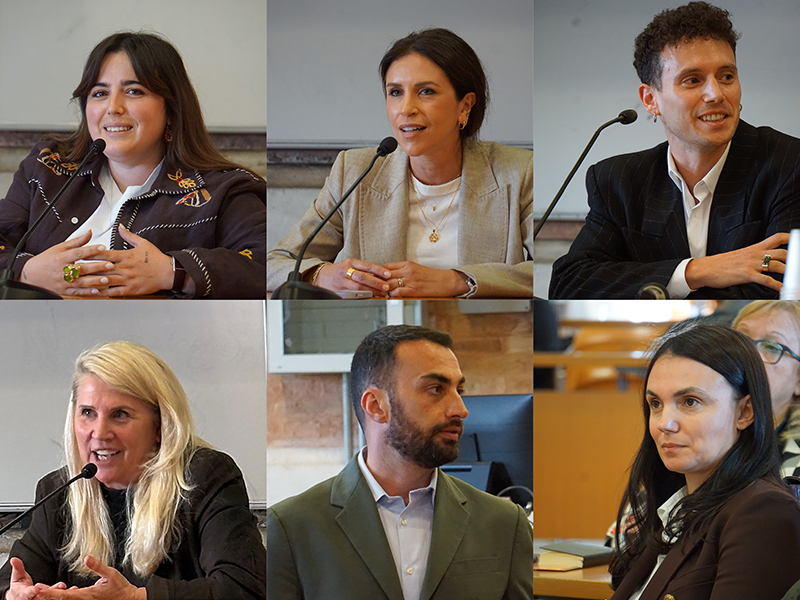
On April 22, 2026, the Aula Magna Cazzavillan at the San Giobbe Economics Campus hosted an afternoon of dialogue dedicated to the world of luxury. “The new codes of luxury: branding, communication and career paths” was, above all, a concrete expression of what the Venice School of Management builds every day: an educational model capable of connecting academia and industry, theory and practice, students and professionals. Organised by VSM and VSM Alumni, with the collaboration of the Ca’ Foscari Luxury Society student association, the event brought into the business school not only experiences, but real trajectories. In this context, Venice was not simply a backdrop; it became an integral part of the educational approach. A city where luxury is lived before it is studied, transforming the academic journey into a continuous dialogue with reality.
From classroom to industry: the role of alumni
The first roundtable focused on one of VSM’s most strategic assets: its alumni community. Moderated by Daniela Pavan, coordinator of the VSM Alumni community, the session brought back to the classroom three graduates now working in different areas of the luxury sector.
Martina Aimetti, Elena Mazzuccato, and Alessandro Vecchiato shared diverse career paths, all rooted in their academic experience at VSM. The discussion highlighted a key insight: the skills developed at San Giobbe are not only theoretical, but deeply interpretative. In luxury, as Alessandro Vecchiato emphasised, understanding the client means going beyond data and interpreting them as a cultural phenomenon, capturing the symbolic, social, and identity-driven dimensions that shape their choices. In this sector, consumption is often an expression of identity, belonging, and aspiration; being able to read these elements allows professionals to build deeper and more meaningful relationships, going beyond the simple transaction. Similarly, as Martina Aimetti pointed out, in a context saturated with content, the ability to distinguish between authenticity and representation becomes essential. For luxury brands, this means crafting narratives that are credible and consistent with their identity, avoiding the risk of purely aesthetic or artificial communication that could undermine trust. Finally, according to Elena Mazzuccato, the integration of technology and human relationships is a crucial competence. Advanced tools such as CRM systems and artificial intelligence are now indispensable, but they must be used to enhance—rather than replace—the relational dimension, keeping recognition and personalization at the core of the customer experience. True expertise lies in using technology to enrich relationships while maintaining a strong human connection.
These are the competencies that define today’s luxury industry and that find fertile ground in a Venetian education, thanks to its constant exposure to a unique context. In this sense, alumni are not only success stories, but act as a bridge between university and industry, making education immediately relevant.
Venice as a laboratory: when the city enters the classroom
The second roundtable shifted the perspective—from those who started in Venice to those who have chosen Venice as a place to work and develop projects. Moderated by Cinzia Colapinto, the session focused on the so-called “Venice factor”: a set of characteristics that make the city a unique context for contemporary luxury. Elisabetta Armellin, Danilo Quagliozzi, and Blerina Pilkati demonstrated how Venice is not only heritage, but also a platform for experimentation. Their experiences clearly show that building an authentic identity in a context with such a high symbolic density requires the ability to engage with the city without being overwhelmed by it. Venice, with its powerful imagery, challenges brands to avoid stereotypes and develop a distinctive voice capable of reinterpreting the context in a contemporary and credible way. At the same time, the luxury sector demands a careful balance between tradition and innovation. Professionals must be able to distinguish what needs to be preserved—because it defines the brand’s identity—from what can evolve in response to changing markets and customer expectations. Much of a brand’s relevance today lies in managing this balance effectively.
Finally, the territory itself emerges as a strategic lever. Venice is not just a backdrop but an integral part of the value proposition: it inspires products, shapes communication, and enriches the customer experience. Being able to transform the local context into a distinctive element means building a competitive advantage that resonates internationally.
A learning model that continues over time
What clearly emerges from this event is a specific vision: education does not end in the classroom. Events like this make the VSM model tangible—an approach built on a continuous connection with the professional world, allowing students to engage with real cases. Learning extends beyond the classroom through ongoing dialogue with companies, institutions, and professionals, helping students understand market dynamics and develop immediately applicable skills, reducing the gap between study and work.
This approach is strengthened by the active involvement of alumni, who return to the classroom as speakers and contributors, building a bridge between generations and creating concrete opportunities. Completing this model is the use of the territory as a learning lever. Venice, with its cultural and economic complexity, offers students an open-air laboratory in which they can observe, interpret, and experiment. This immersive approach fosters a sensitivity that goes beyond technical skills. The alumni community, in particular, represents a natural extension of the academic journey: not just networking, but the transmission of knowledge, the creation of opportunities, and the development of real career paths.