

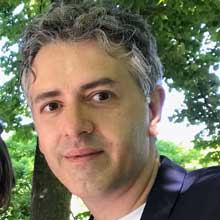
Rocco TRIPODI
- Qualifica
- Ricercatore
- Telefono
- 041 234 8644
-
rocco@unive.it
- SSD
- Informatica [INFO-01/A]
- Sito web
-
www.unive.it/persone/rocco (scheda personale)
- Struttura
-
Dipartimento di Scienze Ambientali, Informatica e Statistica
Sito web struttura: https://www.unive.it/dais
Sede: Campus scientifico via Torino
Stanza: studio 514A (edificio Alfa, 5° piano)
Rocco Tripodi is Assistant Professor (RTD-B) at Ca' Foscari University of Venice. He completed his Ph.D. in Computer Science at Ca’ Foscari University of Venice in 2015 with a thesis titled "Evolutionary Game Theoretic Models for Natural Language Processing,” in which he proposed different learning models based on game theoretic principles for Natual Language Processing (NLP) tasks such as Word Sense Disambiguation and Document Classification.
He was Assistant Professor at University of Bologna (2021-2024), Research Assistant and Adjunct Professor at Ca’ Foscari University, where he worked on lexical semantics and taught Corpus Linguistics, Natural Language Processing and Digital Text Analysis. He worked as researcher in different laboratories including Sapienza NLP at Sapienza University of Rome and European Centre for Living Technology (ECLT) in Venice and under different European projects including ODYCCEUS (www.odycceus.eu), MOUSSE (www.mousse-project.org) and Polifonia (https://polifonia-project.eu).
Rocco Tripodi has a multidisciplinary attitude. He worked on both Computer Science and Linguistics departments and groups. His research interests are in the areas of machine learning and NLP with a focus on lexical semantics and natural language understanding. He is particularly interested in learning models based on transfer learning principles and on the design, learning and evolution of linguistic communication systems.
Le informazioni riportate sono state caricate sul sito dell'Università Ca' Foscari Venezia direttamente dall'utente a cui si riferisce la pagina. La correttezza e veridicità delle informazioni pubblicate sono di esclusiva responsabilità del singolo utente.