Science and Technology of Bio and Nanomaterials: Natsuki Miki is the first graduate of the Double Degree programme with the Kyoto Institute of Technology



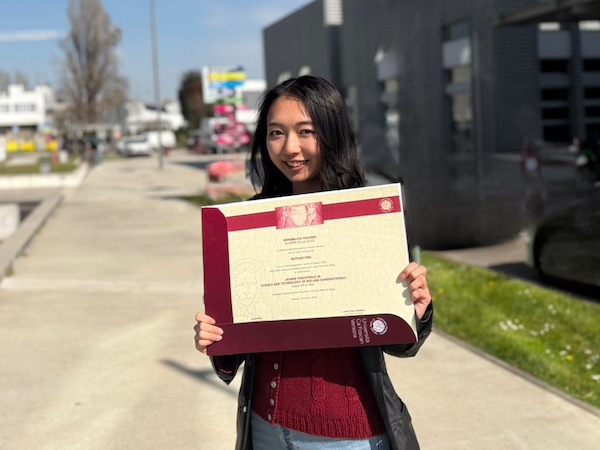
The Department of Molecular Sciences and Nanosystems celebrates a notable milestone: Natsuki Miki is the first student to earn a double Master’s degree in Science and Technology of Bio and Nanomaterials (Ca’ Foscari University of Venice) and Materials Science (Kyoto Institute of Technology, KIT).
Under the supervision of Professor Claudia Crestini (Ca’ Foscari) and Professor Kazuya Matsuo (KIT), the new graduate presented an innovative thesis titled 'Development and Optimisation of Lignin-Based Nanocarriers for Paclitaxel.' This accomplishment highlights both academic excellence and the growing importance of women in STEM fields, shaping the future of research.
“Working with Natsuki on the development of lignin-based nanocarriers has been extremely stimulating,” commented Professor Crestini. “Her ability to integrate the principles of sustainable chemistry with modern therapeutic approaches exemplifies how an interdisciplinary approach is the only true key to tackling the complex challenges of our time. Natsuki has succeeded in turning an academic bridge into a genuine opportunity for scientific innovation.”
Natsuki’s academic journey is notable for its strong multidisciplinary emphasis, combining expertise in chemistry, biology, and materials science. Thanks to the Double Degree agreement with KIT — one of more than 50 dual or joint degree programmes offered by Ca’ Foscari — students have the opportunity to spend their second year at the partner institution and graduate with two academic qualifications.
“The milestone achieved by Natsuki confirms that the collaboration between Ca’ Foscari and the Kyoto Institute of Technology produces research of the highest calibre,” Prof. Prestini concludes. “Seeing a young scientist move so confidently between laboratories and cultures makes us proud: this is precisely the model of global education we are committed to pursuing.”
From Kyoto to Venice: the international experience of Natsuki Miki
Reflecting on her choice to undertake this journey and the challenges of a new country, Natsuki explains:
“When the opportunity arose to become the first student from Kyoto Institute of Technology (KIT) to join the Double Degree program in Venice, I felt a magnetic pull. I wasn't just moving from one city to another; I was moving between two "water capitals" that share the same soul of preservation and artistic heritage. Arriving in February 2025, I stepped into the role of a pioneer: to open a new door for future students, I had to be more than a student—I had to be an ambassador.”
“I arrived with very limited Italian”, she continues, “yet I never felt like a stranger. Even though I couldn't understand or speak the language, I was deeply moved by the friendliness of the local people. As a non-native speaker in a high-level STEM environment, communication was a constant hurdle. Explaining complex chemical reactions or structural analyses in English required a level of precision that sometimes felt out of reach during rapid-fire lab meetings. To bridge this gap, I developed a "Visual-First" strategy. I relied heavily on diagrams, flowcharts, and hand-drawn illustrations. I found that while words can be ambiguous, a well-constructed diagram is a universal language. ”
“At Ca’ Foscari, I chose to immerse myself in the world of lignin, a field that was entirely different from my previous studies in Japan,” she explains, reflecting on her research path. “Under Professor Claudia Crestini’s guidance, I began to see lignin not as a waste product of the paper industry, but as a "golden polymer" with the potential to replace petroleum-based plastics. Professor Crestini's passion was contagious. As a leading female figure in STEM, she taught me to look at the molecular complexity of nature with both rigour and imagination. Working on the valorisation of lignin in a city as ecologically fragile as Venice made the mission feel urgent.”
Her experience in Venice and Kyoto also offered her a broader perspective, in which scientific research engages with contemporary social and environmental challenges:
“Living in Venice as a resident of Kyoto gave me a unique sociological perspective. Both cities are world-class historic sites grappling with identical issues: over-tourism and the preservation of local life. Walking across the Accademia Bridge every morning, I felt the weight of this responsibility. As a student of green chemistry, I realised that my work is part of the solution to preserving these historic cities. We need new materials and sustainable ways of living that don't destroy the very heritage we cherish. ”
Finally, looking to the future and addressing a message of encouragement to other young women scientists, Natsuki concludes: “Being the first Japanese graduate of this Double Degree programme is an honour I carry with pride. To my fellow female STEM students considering a path like this: do not fear the "first" step. The challenges—the paperwork, the language barriers, the culture shock—are simply the friction that polishes your character.
My time at Ca' Foscari, guided by the brilliant Professor Crestini and fueled by the generous spirit of the Venetian people, has redefined my future. I return to Japan not just with two degrees, but with a global identity and a heart full of memories. I am captivated by the beauty of Italy, and I know for certain that I will return. To Venice, to the lab, and to the lovely people who made me feel at home: Thank you very much!!”