
Marco Sgarbi begins his 2026-2032 term as Rector on 1 October



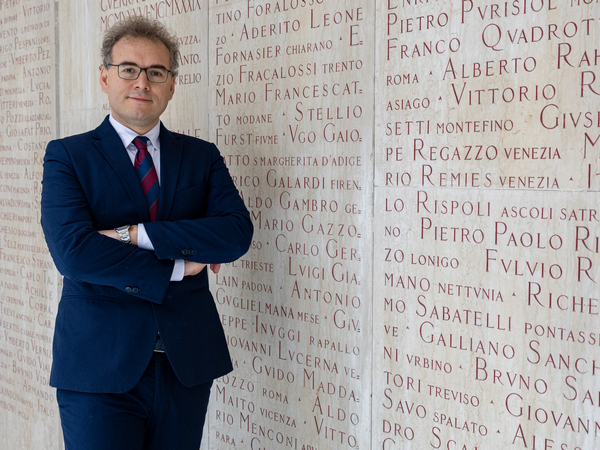
Marco Sgarbi’s term as Rector began on Thursday 1 October. He will lead Ca’ Foscari for the six-year term 2026-2032, becoming the University’s 24th and youngest Rector.
The start of his mandate was marked by the symbolic handover from outgoing Rector Tiziana Lippiello. “I would like to express my gratitude to Tiziana Lippiello, who, over the past few months, has been extremely helpful in ensuring the handover was as smooth and straightforward as possible. She has led Ca’ Foscari with great dedication and achieved important results, promoting our University throughout the world. It is with great emotion and a strong sense of responsibility that I begin this journey today at the helm of the University, putting my experience and commitment at its service. I will do everything I can to contribute to its future.”
The Rector then presented his objectives, his vision for the University of the future and his governance team, comprising 16 Vice-Rectors and 33 Delegates.
Laura De Giorgi, Deputy Rector with responsibility for Relations with Asia, spoke after the Rector’s opening address: “Ca’ Foscari University is a bridge. For us, this image has a very concrete meaning. Ca’ Foscari was founded with its eyes on the world: on foreign languages, trade and distant cultures. Today, we are among Italy’s most international universities, with students arriving from all over the world and graduates working in dozens of countries. But being international today cannot simply be a matter of numbers or exchanges. We live in a time of tensions, with borders becoming more rigid and dialogue breaking down. In this context, a university has an additional responsibility: to keep channels for scientific and cultural dialogue open, with clear-sightedness but without being naive.”
Students
One of the first measures is to raise the ISEE (Equivalent Economic Situation Indicator) threshold for the no-tax area to €30,000. “No talented student should have to give up the opportunity to enrol because of their financial circumstances,” said the Rector, adding: “Ca’ Foscari will invest more than €650,000 a year in this measure. We will submit the proposal to the University’s governing bodies at the earliest available meeting.”
The Rector also announced the creation of a single integrated support system for students, which will accompany them from initial guidance through to their first employment contract, identifying signs of difficulty before they lead to students dropping out. No one should be left alone: personalised services will be provided for working students, students with specific learning disabilities, international students, student carers and students in vulnerable circumstances.
“What our students make of their university experience and what they learn at Ca’ Foscari will shape the future of our country and of Europe. This is why,” said the Rector, “we are putting students at the heart of everything we do, for a better future.”
The Rector’s plans also include making better use of University spaces, beginning with Ca’ Foscari’s libraries, which are spread across nine sites in Venice’s historic centre and on the mainland. “Our libraries are public spaces that I envisage becoming increasingly integrated into the city,” the Rector said. “Everyone has the right to access a public space for study, which is why one of my projects is to make the most of our libraries, encouraging their use and opening them up to the city.”
An Institute for Future Studies
The plans include an Institute for Future Studies and Strategic Foresight where, the Rector explained, “interdisciplinary research will address the major transformations of our time. Not simply another organisational structure, but an intellectual infrastructure that gives concrete form to our vocation: not to be passive in the face of the future, but to study it and help shape it. Work is already under way: we now have a specific Delegate for Future & Foresight Studies.”
The multi-campus model
Venice as the University’s centre of identity and international outlook, Mestre as its scientific and technological hub, and Treviso as a laboratory for business education. Not three sites competing with one another, but a single project in which a plurality of locations strengthens the University’s unity.
This encapsulates the Rector’s multi-campus vision, under which “’the city’ is not just one place. Venice, Mestre and Treviso are distinct urban settings, each with its own social, cultural and economic dynamics. A university that brings the city to life must engage with this plurality not sporadically, but through a differentiated and coordinated strategy that recognises the distinctive strengths of each area and connects them. The University will need to develop specific programmes in each area, but within a single coordinated framework, so that the multi-campus model is not simply about distributing activities across different locations, but becomes an integrated civic strategy.”
According to the Rector, particular attention must be given to the Mestre site, whose urban context differs profoundly from Venice and is therefore of strategic importance. “In a predominantly residential area undergoing urban transformation and home to an increasingly young and multicultural population, the University can play a decisive role in regeneration, social innovation and the creation of spaces for cultural participation. Ca’ Foscari’s presence in Mestre can become a permanent point of reference for public initiatives, partnerships with schools, associations and third-sector organisations, as well as projects relating to urban sustainability, the green transition, technological innovation and dialogue with the metropolitan business community. Strengthening the cultural identity of the Mestre campus means making a tangible contribution to the vitality of the mainland and consolidating Ca’ Foscari’s role as a metropolitan player.”
Buildings and infrastructure
We inherit from the previous Rector’s term an ambitious development programme that places particular emphasis on student spaces and accommodation. We will continue along this path by completing the projects already under way: the new multi-purpose building at the Scientific Campus in Via Torino, which will complete the Scientific Campus project; the redevelopment of the former Pepe and Bellemo barracks on the Lido to create a new student residence; the renovation of Palazzo Rio Novo as a humanities hub, providing suitable spaces for the humanities departments; the new Treviso Campus, with classrooms and student spaces designed to provide a complete university experience; the “Ai Frari” complex, developed with ESU Venezia, which will provide social spaces for students as well as new classrooms; and, finally, the restoration of the Church of Santo Spirito, which will become a multi-purpose space open to the city. These will be spaces for studying, living and sharing the university experience. Further investment will also be made to address student accommodation needs in Treviso and to secure a permanent home for our Challenge School.
Relations with the local area and community
The Rector said: “I would like to establish a lasting civic pact with our local area and community— the Municipality of Venice, the Municipality of Treviso, the Veneto Region and all the municipalities in the areas where we operate — based on shared priorities and objectives that are periodically reviewed and reaffirmed. We also need systematic agreements with businesses to support the local area and transform the legacy of the major projects funded through the National Recovery and Resilience Plan (PNRR) into permanent infrastructure.”
High-quality teaching
“If artificial intelligence makes access to content almost free,” the Rector continued, “those who thrive will be those who recognise that the value of a university has never lay in simply transmitting knowledge, but in transforming people through the experience of thinking together, in person. We will not try to compete with online learning on its own terms: instead, we will double down on what makes the in-person experience irreplaceable.”
The Rector plans to translate this principle into the following objectives:
— In-person learning as a competitive advantage: studying art history in front of Titian’s works at the Frari, studying environmental sciences while observing the lagoon as a living system, or studying economics within a real urban laboratory. No platform can replicate these experiences.
— Active teaching and challenge-based learning, using real-world problems brought into the classroom by businesses and institutions such as museums and public administrations, so that the classroom becomes a place where ideas are produced rather than simply received.
— The establishment of a Centre for Teaching and Learning, focused on advanced and innovative teaching methods. Learning practices and technologies are changing at an extremely rapid pace, and we must lead that change rather than simply react to it.
Research for the future
“Ca’ Foscari has all the expertise, talent and energy it needs to play a leading role in this transition. The quality of its research, its international outlook and the breadth of its academic disciplines provide a solid foundation that must first and foremost be recognised and supported. The aim is not to redefine research priorities from the top down, but to create the conditions in which every area of research, from well-established fields to emerging ones, can realise its full potential, with equal recognition and appropriate support. From this perspective, alongside strengthening basic research and existing research trajectories, it is important to encourage exploration of emerging fields: the interactions among artificial intelligence, language and society; the redefinition of economic models in the context of the climate crisis; new global geographies shaped by hybrid conflicts and complex patterns of mobility; the relationship between the environmental transition and social transformation; the evolution of democratic institutions in the digital age; and the circulation and transformation of cultural heritage in an interconnected world. The goal is to broaden the horizons of research by bringing different areas of expertise into dialogue and supporting research pathways that cross disciplinary boundaries.”
Marco Sgarbi
Marco Sgarbi (1982) has taught History of Philosophy at Ca’ Foscari University of Venice since 2014 and has been a Full Professor since 2021. He has pursued an international academic career, holding visiting professorships and research fellowships at prestigious institutions and research centres across Europe. He was the Principal Investigator of the 2013 ERC Starting Grant for the research project Aristotle in the Italian Vernacular: Rethinking Renaissance and Early-Modern Intellectual History (c. 1400–c. 1650). He has also been a visiting researcher at the University of Oxford. His research focuses on Renaissance and modern philosophy. His research interests include Aristotelianism, Kantian philosophy, the history of logic and the history of ideas. He has led and coordinated numerous national and international research projects, securing major competitive research funding. Author of numerous monographs and academic articles, he actively contributes to contemporary philosophical debate and serves on the editorial and scientific boards of academic journals and institutions. At Ca’ Foscari, he has held several institutional positions, first as Vice-Rector for Communication and University Promotion and subsequently as President of the University Quality Assurance Board.
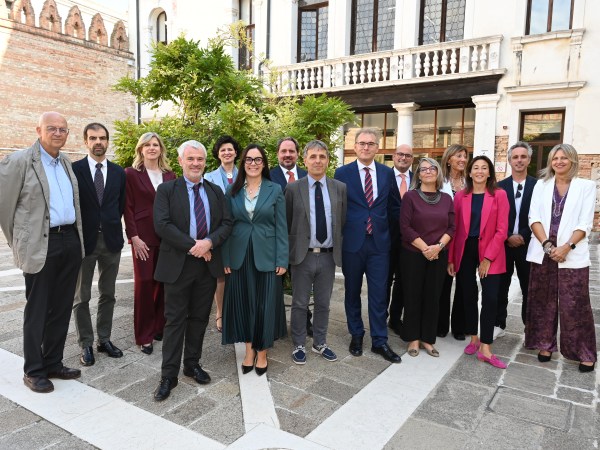
Below is the list of Vice-Rectors and Delegates.
Laura De Giorgi — Deputy Rector, with responsibility for Relations with Asia
Pietro Dino Enrico Dindo — Vice-Rector for Research. Coordinates research policies, from basic to applied research.
Andrea Marin — Vice-Rector for Academic Programmes. Leads the design and development of the University’s academic programmes across its three campuses.
Daniela Favaretto — Vice-Rector for Student Careers. Oversees the entire student journey, from enrolment to graduation, and coordinates student guidance, the student experience and full participation.
Marina Buzzoni — Vice-Rector for Internationalisation and Language Innovation. Oversees international strategies, alliances such as EUTOPIA, and innovation in the field of languages.
Elisa Curti — Vice-Rector for Culture and Public Engagement. Oversees the University’s cultural and civic life across its three campuses, from cultural heritage to institutional events.
Massimiliano Costa — Vice-Rector for Education and Teaching Innovation. Develops initiatives to improve teaching quality and new forms of active learning.
Claudia Irti — Vice-Rector for General, Institutional and Legal Affairs. Oversees institutional, legal and regulatory matters.
Vania Brino — Vice-Rector for Wellbeing. Oversees organisational wellbeing and quality of life for those who study and work at the University.
Marisa Agostini — Vice-Rector for Budget and Financial Assessment. Oversees the University’s financial sustainability and multi-year resource planning.
Achille Giacometti — Vice-Rector for Doctoral Studies. Leads the development of doctoral education, at the heart of the University’s investment in the next generation of researchers.
Andrea Stocchetti — Vice-Rector for Organisation, Administrative Simplification, and Health and Safety. Coordinates process simplification and workplace health and safety, which provide essential foundations for the implementation of the University Plan.
Raffaele Pesenti — Vice-Rector for Planning and Programming. Oversees strategic planning and the programming of University activities.
Carlo Bagnoli — Vice-Rector for Development. Leads the University’s development, from university-business relations and technology transfer to the alumni network.
Andrea Torsello — Vice-Rector for Digital Innovation and Artificial Intelligence. Oversees digital transformation and the responsible adoption of AI.
Alessio Rovere — Vice-Rector for Communication. Coordinates the University’s communication strategy and its public and digital presence.
Delegates
Alongside the Vice-Rectors, a network of Delegates oversees the operational areas in which the University Plan is put into practice.
Elisa Barbieri — Delegate for Future & Foresight Studies. Develops future studies and strategic foresight, in coordination with the Institute for Future Studies that is currently being established.
Adrian Saez — Delegate for Student Experience, and for Sports. Oversees the day-to-day student experience and promotes university sport as a form of active citizenship.
Sara Bonesso — Delegate for International Recruitment and for Guidance and Career Development. Supports students from entry into university through to the world of work, with particular attention to the international dimension.
Vanessa Castagna — Delegate for Prospective Student Guidance. Builds relationships with schools and local communities to identify talent at an early stage.
Carolina Negri — Delegate for University Libraries. Supports the strategic development of the University Library System to ensure broad, sustainable and open access to knowledge.
Ines Giunta — Delegate for Full Participation: Specific Learning Disabilities/Disabilities, Vulnerabilities and Equal Opportunities. Coordinates personalised inclusion services to ensure that no student is left behind.
Luis Fernando Beneduzi — Delegate for International Cooperation and Global Development. Develops international academic partnerships, particularly with countries in the Global South.
Emmanuela Carbé — Delegate for Double, Joint and European Degrees. Develops double, joint and European degree programmes.
Elisabetta Ragagnin — Delegate for EUTOPIA and Strategic Alliances. Oversees the EUTOPIA European University alliance and the University’s strategic partnerships.
Anna Morbiato — Delegate for Languages and Artificial Intelligence. Explores the intersection between language skills and artificial intelligence.
Marco Zappa — Delegate for the Valorisation of Languages and Cultures. Promotes the University’s distinctive linguistic and cultural heritage.
Fabio Caon — Delegate for the Promotion of Italian. Promotes and safeguards the Italian language within and beyond the University.
Simone Piazza — Delegate for Cultural Heritage. Oversees the enhancement and promotion of Ca’ Foscari’s cultural heritage.
Luca Rigobianco — Delegate for Memory Culture. Safeguards the University’s historical memory and identity.
Alessandro Farsetti — Delegate for Events. Coordinates University events and official ceremonies.
Alessandra Jacomuzzi — Delegate for Faculty Development. Supports the professional and teaching development of academic staff.
Stefano Micelli — Delegate for Innovation in University-Business Relations. Strengthens structural links between the University and the business community.
Moreno Mancin — Delegate for Professions and Professional Associations. Oversees relations with professional bodies and professions.
Fabrizio Gerli — Delegate for Alumni Engagement. Mobilises the global network of more than 80,000 graduates to enhance the University’s attractiveness and support graduate employment.
Matteo Gigli — Delegate for Technology Transfer. Transforms research results into tangible impact for technology and business.
Stefano Calzavara — Delegate for Cybersecurity. Oversees the University’s cybersecurity.
Pietro Ferrara — Delegate for the University Website. Oversees the University’s digital presence and website.
Chiara Zanardi — Delegate for the Development of the Science and Technology Campus. Develops the Mestre Science and Technology Campus as an integrated research hub.
Anna Moretti — Delegate for the University’s Tourism Strategy and Coordination of Tourism-related Activities. Coordinates the University’s activities relating to tourism, a key issue for Venice.
Stefano Campostrini — Delegate for Social Innovation in the Public Sector and Local Governance. Develops the University’s civic role in its relations with public institutions and local communities.
Agostino Cortesi — Delegate for Buildings, Spaces and Housing. Oversees University spaces and student housing across the three campuses.
Maurizio Falsone — Delegate for Trade Union Relations. Oversees dialogue with staff representatives and trade unions.
Salvatore Orlando — Delegate for Resource Allocation Models and Calendars. Ensures transparency in resource allocation and oversees the organisation of academic calendars.
Antonio Trampus — Delegate for the Development of Activities with the Port Authority and City-Port Relations. Develops the University’s strategic relationship with the Port Authority and the city.
Silvia Panfilo — Delegate for University Sustainability. Oversees the University’s environmental and social sustainability.
Francesco Casarin — Delegate for Relations with Cultural Foundations. Supports the Rector in building and managing institutional relations between the University and cultural foundations and institutions in the local area.