

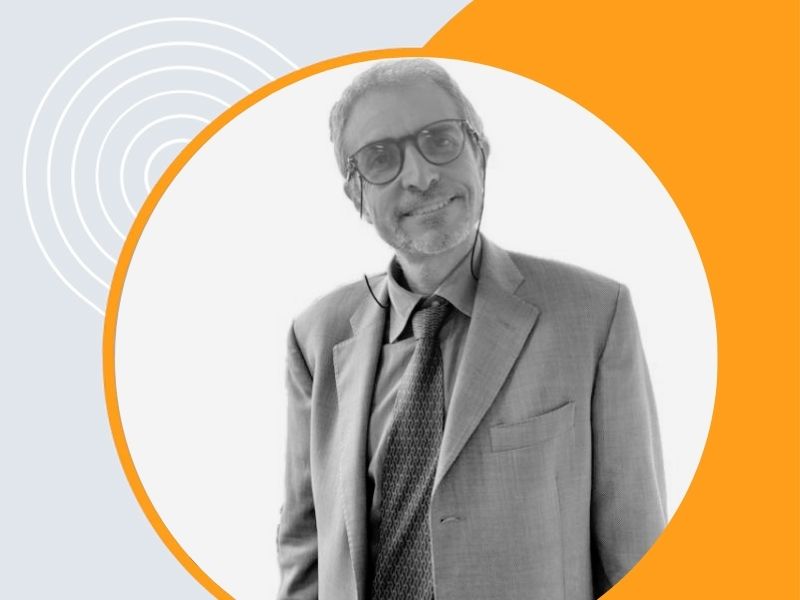
A Life at the Heart of Global Monetary Policy
Bachelor's Degree: Business Administration and Management
After an initial experience as a trader in London, Guido Della Valle joined the European Central Bank in 2000, where he first contributed to the development of the foreign reserve management framework and then took charge of the team for liquidity management and monetary policy implementation. In this capacity, he led the refinement of the ECB’s monetary policy implementation, liquidity management and central banks’ liquidity lines frameworks, as well as the design of several monetary policy instruments and operations.
During the global financial crisis, he played a leading role in the design and implementation of several non-standard monetary policy instruments, from the Asset Purchase Programme to the Targeted Longer-Term Refinancing Operations and the negative interest rate policy. From January 2016 to August 2018 he served as an IMF advisor to the Governor of the Bank of Albania on monetary policy design and implementation; from August 2018 to September 2020 he continued working for the IMF as a short-term expert on more than twenty technical assistance missions covering monetary policy design and implementation, the design of open market operations, FX policy and operations, and government securities market development.
Guido Della Valle rejoined the IMF in 2024 as Advisor on Monetary and FX Policy and Operations for Southern African countries. In this role he coordinates the provision of technical assistance on monetary policy and operations, FX policy and operations, communication and transparency to thirteen central banks across Southern Africa.
From the trading floors of London to the corridors of the ECB and the IMF, his career has run alongside some of the most defining moments of recent economic history. In this conversation, he looks back on that path and shares what it has taught him.
After your degree in Business Economics at Ca’ Foscari, your journey took you from Venice to London, Frankfurt, Washington D.C. and today to Mauritius, working for many years at the European Central Bank and later for the International Monetary Fund, an institution you still collaborate with today. Could you briefly tell us about your professional path and what your work consists of today?
It is a long story. I started as trader in London at Banca Intesa, a first experience for which I will be forever grateful to my Ca Foscari Professor, Maria Bergamin. She helped me a lot to get this first job. It was a brief experience, where I learnt a lot. While I was waiting for the condition to ripen to go back to Italy, I received an offer from an investment bank. They tripled my salary. I could not turn it down. It was brief, exciting, but mentally and physically draining. So in 2000 I was happy to change context and join the ECB.
I spent 15 exciting years at the ECB, first to contribute to setting up a leading central bank from scratch and then to contribute to fighting an existential threat to the euro. In 2016 I joined the IMF as Advisor to the Governor of Bank of Albania. The three years I spent in Tirana were the best I have ever spent in my professional career for what I could achieve and the direct relationship between my actions and concrete, tangible results. In 2020 I went back to the ECB for personal reasons. It was no longer the same place as it used to be. So, I was longing for the conditions to ripen to go back to the IMF. I did it in 2024.
It is so professionally and personally rewarding to contribute to preserving macroeconomic and monetary stability in multiple countries and to developing their financial markets, meeting incredibly dedicated and resourceful people with different background and working together to find good solutions for their needs.
You experienced from the inside some of the most delicate moments in recent economic history, from international financial crises to the pandemic, up to the current geopolitical tensions. What was the most complex professional challenge you faced, and what did it teach you?
I remember one anecdote. It was 2011. President Trichet had just held a press conference after the Governing Council meeting and the market sold off and government securities yield spread massively widened. I was in London. I was asked whether we could have started a government securities purchase program and how long it would have taken. My answer was “one week end”. Nobody belived me. I confirmed i could organize it with the right team. I should have flown on Friday from London to Rome. I flew to Frankfurt instead. It was Friday evening. On Sunday evening the Governing Council agreed the launch of the program. On Monday morning we started.
Your current role gives you a privileged vantage point to observe financial changes worldwide. What are the main differences you observe between mature economies and emerging economies in the management of economic and financial policies?
Surprisingly not many. I am always impressed by the dedication, commitment, expertise, ability to devise very ingenious solutions to idiosyncratic problems of many of my counterparties in developing and emerging economies central banks. What they manage to achieve with relatively limited resources in a difficult context is amazing. Probably the main differences are the resources available – advanced economies have much more resources available – and the complexity of the problems many emerging economies face. Another important difference is the openness to embrace change. Advanced economies are more conservative. Emerging economies embrace change and transformation to keep up with an evolving economic ecosystem as the norm.
Throughout your career you have worked in strongly international and multicultural contexts. How much do intercultural skills and the ability to collaborate with people from different countries and cultures matter today?
I think they are essential. In a globalized world, I think the proven ability to work and operate effectively in a multicultural context is a skill more important than many competences. When I was at the ECB, I often oversaw the selection of European trainees. The first thing I was looking for was whether they had studied or worked for at least a semester abroad. This was simply because based on my experience those that had not struggled much more to effectively integrate into my team. For this reason, I have an important advice for students: Erasmus, Erasmus, Erasmus.
Artificial intelligence, data and new technologies are profoundly transforming the financial sector. Which changes do you believe will have the greatest impact on economic and financial institutions in the coming years?
Artificial intelligence, big data, and digital technologies are already reshaping the financial sector. In the coming years, I believe the biggest impact on economic and financial institutions will come from three areas: automation, data-driven decision-making, and cybersecurity. AI will improve risk analysis, fraud detection, and customer services, making institutions more efficient and responsive. At the same time, the growing use of data will strengthen monetary policy, supervision, and financial forecasting. However, these innovations will also increase operational and cyber risks, requiring stronger regulation, governance, and digital skills within institutions. The main challenge will be to balance innovation with financial stability and trust.
If you could go back to the classroom where you studied at Ca’ Foscari in 1996 and give a piece of advice to the young Guido Della Valle, what would it be?
Keep your option open and be ready to seize the opportunities if you see them. In 1996 I had envisaged a very different path for my career. But, along the way, i saw opportunities, and I reaped them. Do you know the real option model? According to this model, a value of a company is the value of all its strategic options; the more strategic options a company has, the more it can pursue profitable opportunities and adapt to a changing, volatile world. The same is for individuals.