

Other international projects
Department of Environmental Sciences, Informatics and Statistics
This section lists the projects in which the Department is involved and which are funded in various ways by international organizations.
ANTIPASTI
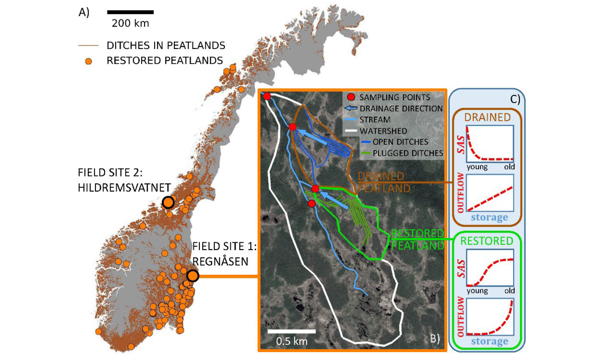
Adapting to climate risks via landscape-scale solutions: effects of peatland restoration on floods and water browning
Project number: Grant Agreement n. 358106
Call identifier: Researcher Project for Scientific Renewal (Thematic Call) - The Research Council of Norway
CUP: H73C25001590006
UNIVE Scientific Director: Enrico Bertuzzo
UNIVE status: partner
Duration: 01/04/2026 - 31/03/2031
Total project cost for the entire consortium: approximately € 1.320.000,00, of which € 230.000,00 co-financing
Budget UNIVE: approximately € 220.000,00, of which € 42.000,00 co-financing
UNIVE research group: Enrico Bertuzzo
Natural hazards like river floods and water browning caused by organic matter washed into aquatic environments are becoming more intense because of climate change. Nature-based solutions such as peatland restoration are often proposed as measures that may help reduce these risks and adapt to climate change. However, the knowledge about the effects of peatland restoration on floods and water browning is limited. The ANTIPASTI project clarifies how peatland restoration modifies the way landscapes retain, transform and release water and biogeochemical elements , and how it affects their capability of modulating floods and aquatic carbon fluxes causing water browning. We measure in the field how quickly discharge of streams reacts to precipitation events and how old is the water released from drained and restored peatlands (a proxy for water quality). These new tools are used to understand interactions between climate change and peatland restoration, assess the effects of this nature-based solution for river floods and water browning, and unveil possible emerging risks. The vision of ANTIPASTI is to create knowledge and tools to enable landscape restoration specifically designed to achieve flood hazard reduction and water quality targets.
Health-AI
Advancing Healthcare with Adaptive AI Training and a Collaboration Platform

Project number: 2025-1-TR01-KA220-HED-000363892
Call identifier: 2025-01-TR01-KA220
CUP: H74E25000140006
UNIVE Scientific Director: Agostino Cortesi
UNIVE status: partner
Duration: 01/10/2025 - 31/03/2028
Total project cost for the entire consortium: € 400.000,00
Budget UNIVE: € 52.654,00
UNIVE research group: Agostino Cortesi, Pietro Ferrara, Alessandro Bernes
The HEALTH-AI project aims to bridge the gap between healthcare and Artificial Intelligence (AI) by providing professionals and students with the knowledge, skills, and ethical awareness necessary for the safe and effective integration of AI into clinical practice. It aims to improve AI skills through an adaptive AI curriculum, strengthen interdisciplinary collaboration and knowledge sharing between informatics scientists and healthcare professionals through a co-creation platform, and promote responsible AI adoption through appropriate ethical guidelines.
BRIDGE
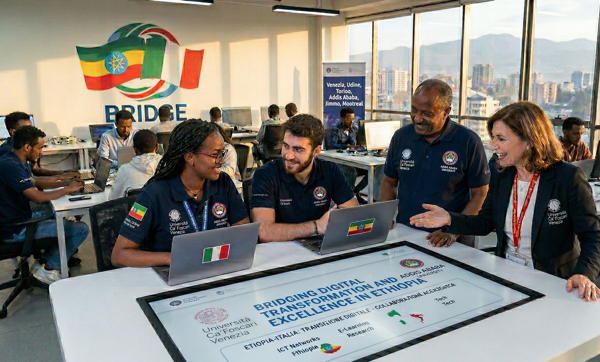
Bridging Digital Transformation and Research Excellence in Ethiopia
Project number: G7_AFRICA-2024-00022
Call identifier: Notice D.D. n. 353 of 18 November 2024, as amended by D.D. n. 369 of 20 December 2024 - Transnational educational initiatives with African countries within the framework of the Mattei Plan and the G7 initiative "Research Capacity Building with Africa" - RCA
CUP: H73C25001250006
UNIVE Scientific Director: Agostino Cortesi
UNIVE status: coordinator
Partnership: Politecnico di Torino, University of Udine, The Institut National de la Recherche Scientifique (INRS), Addis Ababa University (AAU), Jimma University (JU)
Duration: 01/11/2025 - 31/10/2027
Total project cost: € 249.845,00
Budget UNIVE: € 171.845,00
UNIVE research group: Agostino Cortesi
BRIDGE is a collaborative project funded by the Ministry of Education, Universities and Research (MIUR) involving Ca' Foscari University of Venice, the Polytechnic University of Turin, the University of Udine, Addis Ababa University, Jimme University, and INRS Montréal. The overall objective of the project is to establish a collaborative network among the partner universities, including both the exchange of best practices in adopting methods and tools for the digital transition of universities and the development of research projects. Specifically, the activities will be aimed at university managers, directors, and research group leaders focused on digitalization and the adoption of artificial intelligence tools to improve management processes and research quality governance. The activities will also involve university professors, researchers, and doctoral students in a multilateral capacity-building effort on advanced materials and technologies for energy and environmental applications.
Powerful Plants
The Power of Plants as Food, Medicine and Raw Materials Before Agriculture
Project number: Collaboration Agreement between “The University Court of the University of Glasgow” and Ca' Foscari University of Venezia for the implementation of the project “EP/X025160/1 - Powerful Plants: The Power of Plants as Food, Medicine and Raw Materials Before Agriculture - Re. 318152” - Rep. UNIVE n. 86/2023 Prot n. 73844 of 15/03/2023
Call identifier: project originally funded under the Horizon ERC Advanced Grant Call (PI - Karen Hardy), subsequently transferred to “The University Court of the University of Glasgow”
CUP: H73C23000130005
UNIVE Scientific Director: Elena Badetti
UNIVE status: project partner following the signing of a “Collaboration Agreement”
Duration: 09/03/2023 - 30/09/2027
Budget UNIVE: € 162.665,00
UNIVE research group: Elena Badetti, Laura Longo
Website: https://powerfulplants.gla.ac.uk
The POWERFUL PLANTS project, coordinated by the University of Glasgow under the leadership of Professor Karen Hardy, is a major academic research initiative evaluated and approved by the European Research Council (ERC) and funded by the UKRI Horizon Europe Guarantee Fund (UK). The project is based on the premise that the complex use of plants—as food, medicine, and raw materials—played a defining role in the social, cultural, behavioural, and technological development of human evolution. Plants are essential to human physical, psychological, and physiological wellbeing, providing energy, nutrients, medicinal substances, and materials. The depth of the relationship between humans and plants suggests that this connection has always been central, although the role of plants before the emergence of agriculture, around 10,000 years ago, remains poorly understood.
POWERFUL PLANTS adopts a strongly interdisciplinary approach, combining archaeology, archaeobotany, experimental archaeology, ethnography, ecology, and neuroscience to investigate three main areas in which plant use was crucial in shaping human trajectories: diet and health, medicine and the mind, and technology and society. Through this integrated perspective, the project aims to reconstruct the role of plants in the daily practices, survival strategies, knowledge systems, and technological innovations of prehistoric communities, with implications that remain evident today.
The DAIS research group at Ca’ Foscari, composed of Laura Longo and Elena Badetti, contributes to the project by focusing on the recovery and characterization of plant residues adhering to lithic tools selected from some of the earliest Upper Palaeolithic contexts, including the site of Dzudzuana in the Caucasus, dated to approximately 36,000 years ago. Through the analysis of these tools, the research group aims to identify traces of starches, dyes, fibres, and other plant components, providing new evidence on the use of plants by Palaeolithic populations.
EcoDigify
Enhancing the capacity of European Universities to drive Green Digital Transformation through a Transdisciplinary and Action-Oriented Approach to integrate Sustainable Digitalization into Higher Education Curricula

Project number: 2024-1-SE01-KA220-HED-000250071
Call identifier: 2024-01-SE01-KA220
CUP: H74E24000050006
UNIVE Scientific Director: Agostino Cortesi
UNIVE status: partner
Duration: 01/09/2024 - 30/06/2027
Total project cost for the entire consortium: € 400.000,00
Budget UNIVE: € 86.975,00
UNIVE research group: Agostino Cortesi, Pietro Ferrara
Website: https://www.ecodigify.eu
The EcoDigify project aims to build university-level training courses of an interdisciplinary nature to promote sustainability in the use and development of digital technologies. This will be achieved by providing teachers with materials and tools on sustainable digitalisation and providing students with the knowledge and skills to create sustainable digital solutions with the support of experts and researchers working in the field of sustainability.
ATLAS
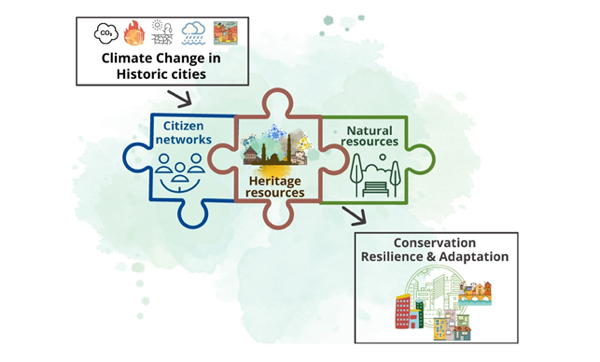
Studying symbiotic scenarios linking Heritage assets and green areas to prepare Historic Cities to face Climate Changes
Project number: CCH23_00082
Call identifier: International Call “Collaborative Research Action (CRA) on Climate and Cultural Heritage” (CCH 2023)
CUP: H73C23001380005
UNIVE Scientific Director: Edy Fantinato
UNIVE status: partner
Duration: 01/05/2024 - 30/04/2027
Total project cost: € 833.500,00
Budget UNIVE: € 296.000,00 (of which € 207.200,00 of external financing and € 88.800,00 of UNIVE co-financing)
UNIVE research group: Edy Fantinato, Elisabetta Zendri, Eleonora Balliana, Francesca Caterina Izzo, Simone Marino Preo
ATLAS aims to bring about positive change for local authorities and stakeholders in the assessment and management of the relationship between green spaces and historic buildings. The project proposes an approach to risk analysis with the aim of developing innovative tools that facilitate the assessment of the multiple hazards, vulnerabilities and risks associated with the conservation of heritage and green spaces in historic cities, while ensuring careful use of public funds. In addition, protocols will be established to promote the implementation of sustainable adaptation and mitigation strategies based on integrated and participatory management of green spaces and heritage resources.
IAM
Access control policies verification and inference

Call identifier: AMAZON - AWS Automated Reasoning call for proposals
Funding body: AMAZON
CUP: H75F21001120007
UNIVE Scientific Director: Pietro Ferrara
UNIVE status: coordinator
Durationta: 01/10/2021 - 30/09/2024
Total project cost: € 67.957,87
Budget UNIVE: € 67.957,87
UNIVE research group: Pietro Ferrara, Software and System Verification lab
AWS IAM access control policies specify what AWS cloud resources are accessible by what identities. AWS SDKs allow developers to programmatically access these resources through applications that can be run by different identities. However, what resources are accessed and how depend on the (mostly string) values computed by the application. Therefore, forecasting what access control policy is required by a given application is rather complex. In this project, we apply abstract interpretation techniques to over approximate the string values computed by these applications, and then infer, validate or IAM the access control policies.